Jan Martszen de Jonge: A Flemish Landscape Painter Amidst Baroque Splendor
Jan Martszen de Jonge (1609 – 1647) remains an artist whose contribution to Dutch Golden Age art deserves deeper exploration, despite his relative obscurity compared to luminaries like Rembrandt and Vermeer. Primarily active in Haarlem, Martszen’s oeuvre distinguishes itself through a fascinating duality—a synthesis of Flemish artistic traditions with the stylistic innovations characteristic of the Baroque period. This blend reflects not merely stylistic preferences but also a profound engagement with the intellectual currents shaping Europe during his lifetime.
- Early Life & Training: Precise biographical details surrounding Martszen’s formative years are scarce, adding to the mystique surrounding this talented painter. He apprenticed under Hans van Steenwyck II, a Haarlem landscape master renowned for dramatic compositions and meticulous detail. This influential mentorship undoubtedly instilled in Martszen a foundational understanding of Flemish landscape aesthetics—characterized by atmospheric perspective, luminous color palettes, and an emphasis on conveying mood and emotion through visual cues.
- Stylistic Characteristics: Martszen’s artistic style is notable for its harmonious fusion of Baroque grandeur and Flemish realism. He excelled in capturing the dynamism of battle scenes with impressive accuracy—a genre that gained considerable popularity during his era, fueled by ongoing conflicts between European powers. However, he wasn't solely focused on military subjects; he produced serene landscapes imbued with subtle tonal variations and evocative lighting effects.
- Notable Works & Collaborations: Martszen’s artistic prowess extended beyond individual paintings. He collaborated closely with Jan Brueghel the Elder, a celebrated Flemish painter known for monumental landscapes and allegorical narratives—a partnership that exemplifies the cross-border exchange of ideas and techniques prevalent in 17th-century art circles. This collaboration underscores Martszen's position within the broader artistic landscape of Haarlem during its zenith.
- Influence & Context: Martszen’s artistic sensibilities were undoubtedly shaped by the intellectual environment of Haarlem—a city actively engaged in scientific observation and mirroring the burgeoning interest in natural history. This engagement is particularly evident in his landscapes, which demonstrate a keen awareness of geological formations and seasonal changes.
- Legacy & Significance: While Martszen’s fame didn't rival that of Rembrandt or Vermeer, his paintings continue to resonate with viewers today due to their skillful execution and expressive qualities. He represents a crucial link between Flemish landscape painting and the Dutch Baroque tradition—a testament to Haarlem’s artistic vitality during its Golden Age. His contribution to documenting military events provides valuable insight into the visual culture of the time.
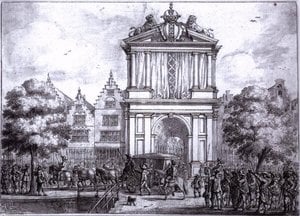
The Entry of Maria de' Medici to Amsterdam: A Monumental Scene Captured in Etching
“The Entry of Maria de’ Medici to Amsterdam,” created in 1638 by Jan Martszen de Jonge, stands as a compelling example of Baroque artistic achievement. This etching portrays a grand procession through what appears to be a city square—a pivotal moment in Dutch history marked by the arrival of Maria de' Medici, Queen consort of Louis XIII and Marie Theresa of Bavaria, representing a significant diplomatic alliance between France and the Netherlands. The artwork’s meticulous detail captures the splendor of the occasion, reflecting the artistic sensibilities of its time.
The etching meticulously depicts a monumental archway adorned with lions and a shield—a symbol of royal authority and prestige—serving as the focal point for the procession. Surrounding figures are dressed in opulent attire, conveying the importance of this diplomatic event. The architectural backdrop incorporates stepped gables characteristic of Dutch Golden Age architecture, enhancing the sense of scale and grandeur.
Technical Skill & Artistic Vision
Martszen’s etching technique demonstrates remarkable precision—a hallmark of Flemish engraving during the Baroque period. He skillfully employs hatching and shading to convey depth and texture, capturing the nuances of light and shadow with exceptional realism. The artist's careful attention to detail ensures that every element of the scene is rendered faithfully, conveying not only visual accuracy but also an emotional resonance that reflects the grandeur and spectacle of Maria de’ Medici’s arrival.
Historical Context & Symbolism
The etching’s depiction of “The Entry of Maria de' Medici to Amsterdam” encapsulates a crucial juncture in European diplomacy—the consolidation of alliances between France and the Netherlands following years of conflict. The procession itself symbolizes royal power and diplomatic success, while the architectural elements contribute to establishing a sense of solemnity and grandeur. Martszen’s artwork serves as a visual record of this historic event, reflecting the artistic values prevalent during Haarlem's Golden Age.
A Lasting Impression
“The Entry of Maria de Medici to Amsterdam” by Jan Martszen de Jonge continues to captivate viewers today due to its masterful execution and evocative portrayal of a significant moment in Dutch history. It exemplifies Martszen’s artistic legacy—a testament to Haarlem's enduring contribution to Baroque art and landscape painting, securing his place as an artist whose work transcends time.



 Previzualizare
 Comandă printul
 Trimite
 Distribuie
 Detalii despre lucrare

 Descarcă
 Produse similare
 Radiografie
 Diapozitive automate


 Vezi mai mult






































 Opțiunea cu sticlă este disponibilă doar pentru dimensiuni de sub 110 cm