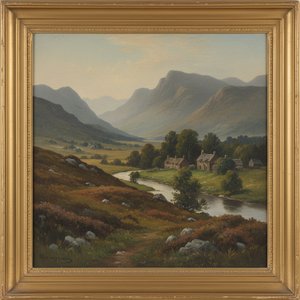
The Soul of the Portrait: The Life and Legacy of William Menzies Tweedie
To step into the world of William Menzies Tweedie is to enter an era of profound elegance and meticulous observation, where the brush served as a bridge between the sitter's social standing and their inner psychological truth. Born in Glasgow, Scotland, on February 19, 1826, Tweedie’s journey was one of destined deviation; though originally intended for a life within the disciplined ranks of the navy, his true calling lay in the delicate interplay of light and pigment. This early tension between duty and art would later manifest in a style defined by both structural rigor and a soft, atmospheric grace.
Tweedie’s artistic maturation was shaped by some of the most prestigious institutions and masters of the nineteenth century. His formal training began at the Edinburgh Academy, where his prodigious talent was recognized early through a prize for his masterful copy of William Etty's The Combat. This foundational period in Scotland provided him with a classical grounding that he would later refine in the cosmopolitan centers of London and Paris. By moving to London in 1846 to study at the Royal Academy and subsequently spending three years in Paris under the tutelage of the renowned Thomas Couture, Tweedie absorbed the sophisticated techniques of tonal blending and nuanced rendering that became his hallmark.
A Mastery of Light and Tonal Sophistication
The technical brilliance of Tweedie’s work lies in his remarkable control over a muted, sophisticated palette. Eschewing the garish for the graceful, he often utilized a spectrum of browns, greys, and ochres to create depth and atmosphere. His method was one of patience and precision; through the careful application of glazing techniques, he built up layers of paint that allowed light to penetrate the surface, imbuing his portraits with a luminous, almost breathing quality. This approach did more than merely replicate a likeness; it captured the very essence of his subjects, lending them a sense of permanence and dignity.
His ability to manipulate shadow and light—a technique deeply rooted in his academic training—allowed him to convey much more than physical presence. In his hands, a portrait became a study of character. Whether depicting the stern authority of a clergyman or the quiet contemplation of an aristocrat, Tweedie utilized subtle gradations of tone to suggest the psychological complexities hidden beneath the surface of Victorian propriety.
A Chronicler of the Victorian Elite
Tweedie’s career was marked by his ability to navigate the highest echelons of British society, earning him commissions that placed him at the heart of historical portraiture. His subjects were not merely faces, but symbols of an era: diplomats, intellectuals, and members of the aristocracy who sought to immortalize their legacy through his refined lens. His notable works include:
- Francis Jeune: A dignified depiction that showcases his ability to render classical realism and authority.
- Henry Labouchere, Baron Taunton: An exploration of status and character through formal portraiture.
- Colonel James Glencairn Burns: A testament to his skill in capturing the essence of military prestige.
As he settled in London, residing in prestigious locales such as Piccadilly, Tweedie became a fixture of the British art scene. His death in 1878 marked the end of a life dedicated to the pursuit of aesthetic perfection. Though his biographical details may occasionally fade into the shadows of history, his contribution to the tradition of Scottish and British portraiture remains indelible. He leaves behind a body of work that serves as a window into the refined sensibilities of the Victorian age, reminding us that true art lies in the ability to capture the fleeting light of a human soul.
Perguntas e Respostas
Onde as obras de William Menzies Tweedie estão agrupadas por palavras-chave?
A página Por palavras-chave de William Menzies Tweedie agrupa as obras do artista por palavras-chave.
Como a arte de William Menzies Tweedie evoluiu ao longo do tempo?
Um relato cronológico da obra de William Menzies Tweedie está disponível na página Linha do tempo do artista, onde as obras são apresentadas em ordem de criação, capítulo por capítulo.
Posso navegar pelas obras de William Menzies Tweedie por paleta de cores?
A página Por paleta de cores agrupa as obras de William Menzies Tweedie por suas paletas de cores.