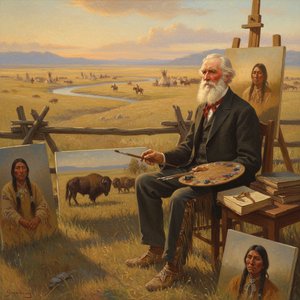
A Life of Bravery and Artistry
White Swan, also known as Mee-nah-tsee-us in the Crow language, was a Crow Scout who served with George Armstrong Custer's 7th Cavalry Regiment during the 1876 campaign. During the Battle of the Little Bighorn, he fought alongside Major Reno's detachment and was the only Crow Scout wounded in action, sustaining severe injuries to his hand, wrist, and leg. Although these wounds left him with a permanent limp and a deformed right wrist, he continued to serve as an Army scout until 1881.
In his later years at the Crow Agency, White Swan transitioned from scouting to creating drawings that depicted key events from his life, including the Battle of the Little Bighorn. These works were purchased by visitors to the battlefield and the agency. His artistic legacy includes:
- Drawings on pages from accounting ledgers.
- Paintings on larger sheets of muslin canvas.
- Illustrations of his war deeds and life events.
Legacy and Personal History
White Swan lived much of his later life at the Crow Agency in the Little Bighorn valley. Due to injuries, he was unable to hear or speak in his later years. He was known by the artist J.H. Sharp as a jolly and good-natured individual. His drawings have since been recognized by collectors and are featured in various exhibitions and collections, such as the Buffalo Bill Historical Center.
White Swan died in 1904 and is buried at the Little Bighorn National Cemetery. He left no direct descendants.
Perguntas e Respostas
Quantas obras de White Swan estão disponíveis para explorar?
Você pode explorar 1 obras de arte obras de White Swan na página Todas as obras.
Posso ordenar as obras de White Swan por cor?
As obras de White Swan podem ser exploradas por cor na página Índice de Cores do artista.
Qual é o nível de popularidade das obras de White Swan?
Existe uma página de Estatísticas para White Swan, apresentando estatísticas sobre as obras do artista no este site.
Existe uma cronologia da carreira de White Swan?
Um relato cronológico da obra de White Swan está disponível na página Linha do tempo do artista, onde as obras são apresentadas em ordem de criação, capítulo por capítulo.