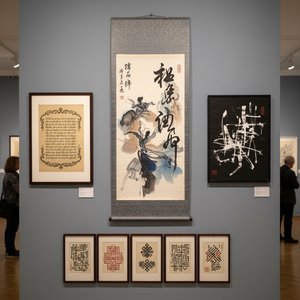
Wang Mingming: Bridging Tradition and Modernity Through Poetic Ink Wash Painting
Wang Mingming, born in Beijing in 1952, stands as a singular figure within the landscape of contemporary Chinese art—a testament to the enduring power of tradition reimagined through a distinctly modern sensibility. His artistic journey began with an instinctive fascination for ancient Chinese painting themes, swiftly evolving into a profound engagement with the spirit and essence of classical calligraphy and poetry. This dual influence permeates his oeuvre, resulting in works that resonate with both timeless beauty and palpable emotion. Early Life & Artistic Beginnings: From humble beginnings in Penglai, Shandong Province, Wang Mingming’s artistic inclinations surfaced early on—a childhood passion nurtured by a self-taught approach and mentored by influential masters like Jiang Zhaohe and Lu Chen. These formative experiences instilled within him an unwavering dedication to mastering the techniques of traditional ink wash painting, shaping his artistic vision for decades to come. He honed his skills diligently from a young age, absorbing the wisdom of seasoned practitioners who championed a harmonious blend of meticulous observation and intuitive expression. Formal Education & Influential Mentors: Wang Mingming’s pursuit of excellence continued with admission to the Central Academy of Art in Beijing, where he honed his skills under luminaries such as Wu Zuoren and Lu Chen—artists who championed a harmonious blend of intellectual rigor and artistic intuition. These mentors instilled in him not only technical proficiency but also a deep appreciation for the philosophical underpinning of Chinese art. They guided him toward understanding that true artistry transcends mere imitation; it demands an engagement with profound concepts rooted in centuries of cultural heritage. Exploration of Ancient Poetry & Landscape Vision: Inspired by the profound cultural heritage of China, Wang Mingming embarked on a deliberate exploration of ancient Chinese poetry—a practice that profoundly informs his artistic process and imbues his paintings with lyrical resonance. He skillfully captures the grandeur of mountainous landscapes, mirroring the contemplative spirit of Daoist philosophy and conveying a sense of sublime beauty. His compositions are imbued with echoes of poetic imagery—references to mountains, rivers, and celestial phenomena—that elevate them beyond mere visual representation into realms of spiritual contemplation. Technique & Style: Wang Mingming’s distinctive style is characterized by expansive brushstrokes—a deliberate departure from Western conventions—that evoke the spaciousness and imaginative freedom of scholar paintings. He employs meticulous control over ink dilution and layering, achieving remarkable textural depth and conveying subtle nuances of emotion. His monumental scrolls, often exceeding ten meters in length, represent a masterful demonstration of scale and perspective. These works embody a profound understanding of artistic materiality—the careful manipulation of pigment and support—to create immersive experiences that transport the viewer to distant vistas and evoke feelings of awe and wonder. He meticulously adheres to traditional techniques, prioritizing balance and harmony while simultaneously pushing boundaries of expression. Recognition & Legacy: Wang Mingming’s artistic achievements have garnered international acclaim—including awards from the International Association of Artists of the United States—solidifying his position as one of China's foremost contemporary ink painters. His work continues to inspire artists worldwide, embodying a timeless commitment to preserving and reimagining the legacy of Chinese art for future generations. He remains steadfast in his dedication to artistic exploration, demonstrating that tradition can flourish alongside innovation—a testament to the enduring power of creative vision.Perguntas e Respostas
Qual é o local e o ano de nascimento de Wang Mingming?
Wang Mingming nasceu em Penglai, em 1952.
Como a carreira de Wang Mingming é dividida em períodos?
A Crônica de Wang Mingming é uma linha do tempo interativa que apresenta as obras do artista em ordem cronológica, agrupadas por períodos de sua carreira.
Posso visitar um museu virtual das obras de Wang Mingming?
Uma visita virtual é possível: a página Museu 3D de Wang Mingming apresenta as obras do artista em uma galeria tridimensional.
Quais cores Wang Mingming utilizou com mais frequência?
O uso da cor em Wang Mingming, através das obras listadas em este site, pode ser estudado na página Genoma da Paleta do artista.
Em quais movimentos Wang Mingming trabalhou?
A página Todos os Movimentos agrupa as obras de Wang Mingming por movimento artístico.
Existe uma lista completa das obras de Wang Mingming?
Todas as obras de Wang Mingming no este site podem ser visualizadas na página de Todas as Obras de Arte do artista.
Que sentimentos as obras de Wang Mingming expressam?
A Sala de Humor de Wang Mingming é uma página que organiza as obras do artista por humor.
Existe uma linha do tempo das obras de Wang Mingming?
A página de Linha do tempo das obras do artista apresenta as obras de Wang Mingming ordenadas por data, ano a ano.