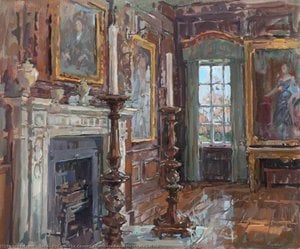
The Enduring Light of Susan Ryder
Susan Ryder, a name synonymous with evocative portraiture and the masterful rendering of interior space, stands as one of Britain’s most respected artists of the late 20th and early 21st centuries. Born in Windsor in 1944, her artistic journey was profoundly shaped by a childhood steeped in the legacy of her father, Robert Ryder VC – an amateur painter whose passion ignited within young Susan a lifelong love for capturing light, shadow, and the essence of human experience. This formative influence, coupled with the guidance of influential teachers like Bernard Dunstan RA, instilled in her a deep appreciation for the Impressionist masters, particularly Vuillard, who became a cornerstone of her artistic vocabulary – a fascination with fleeting moments, subtle color shifts, and the intimate details that reveal character.
Ryder’s early career was marked by a dedication to honing her craft through rigorous study at the Byam Shaw School of Painting in London. She quickly established herself as a talented artist, gaining recognition for her ability to translate complex emotions onto canvas. Her artistic development wasn't solely focused on portraiture; she also explored landscape painting, earning an early award that demonstrated her versatility and technical skill. This dual focus – the intimate portrayal of individuals alongside the exploration of atmospheric interiors – would become a defining characteristic of her work, reflecting a broader interest in capturing the interplay between subject and setting.
A Soldier’s Shadow and the Birth of a Charitable Legacy
Ryder's wartime service with the First Aid Nursing Yeomanry (FANY) proved to be a pivotal experience, profoundly shaping both her artistic perspective and her commitment to humanitarian causes. Her assignment to the Polish section of the Special Operations Executive (SOE) during World War II exposed her to the harrowing realities of conflict and the resilience of those caught in its crossfire. This period instilled within her a deep empathy for the marginalized and forgotten – a sentiment that would later manifest in the establishment of the Sue Ryder Foundation, initially known as the Forgotten Allies Trust.
Following the war, Ryder dedicated herself to assisting displaced individuals, particularly Polish refugees struggling to rebuild their lives after years of persecution. Her tireless efforts involved visiting prisoners in German prisons, advocating for their release, and providing them with essential support. This work, often undertaken at great personal risk, cemented her reputation as a compassionate humanitarian and inspired her to create a lasting legacy through the foundation she established – a testament to her belief that even amidst darkness, kindness and hope could prevail. The stories of these ‘Bods,’ as she affectionately called them, became central to her artistic vision, informing many of her later portraits and underscoring themes of resilience, compassion, and the enduring power of human connection.
The Language of Light: Technique and Style
Ryder’s distinctive style is immediately recognizable for its masterful manipulation of light and shadow. She eschewed photographic realism in favor of a more subjective approach, prioritizing the emotional impact of her paintings over strict adherence to detail. Her use of lamplight – often depicted as pools of warm, diffused illumination – became a signature element, creating an atmosphere of intimacy and introspection within her portraits and interiors. She employed a layered technique, building up color gradually through multiple glazes, achieving remarkable depth and luminosity.
Her compositions are typically carefully considered, with a deliberate emphasis on spatial relationships. She frequently utilized techniques borrowed from the Old Masters – particularly Van Dyck and Cézanne – to create a sense of perspective and atmosphere. Ryder’s portraits aren't merely representations of her subjects; they are windows into their souls, capturing not just their physical appearance but also their inner lives and experiences. The interiors she paints are equally compelling, offering glimpses into private worlds filled with character and emotion.
Notable Works and Lasting Influence
Among Ryder’s most celebrated works is “The Council Chamber, Royal Hospital Chelsea,” a monumental painting that captures the grandeur and serenity of this historic landmark. Her portrait of Sir Michael Scholar exemplifies her ability to convey both dignity and vulnerability in her subjects. Her depiction of The Queen, commissioned for the Platinum Jubilee, stands as a testament to her skill and her deep understanding of royal protocol and symbolism.
Ryder’s influence extends far beyond her own artistic achievements. She is remembered not only as a gifted painter but also as a compassionate humanitarian who dedicated her life to helping those in need. Her work continues to inspire artists and viewers alike, reminding us of the power of art to illuminate the human condition and foster empathy and understanding. Her legacy endures through the Sue Ryder Foundation, which remains committed to providing care and support for people living with serious illnesses.