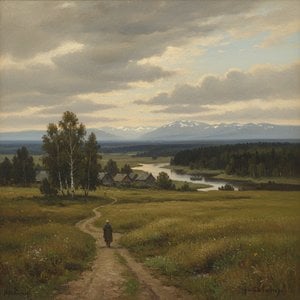
A Legacy of Light and Line
The name Michael Angelo Rooker carries with it a sense of dramatic flair, a moniker bestowed upon him in jest by his mentor, Paul Sandby, yet one that would come to define an artist of profound technical skill. Born in London, United Kingdom, Rooker emerged as a versatile force within the eighteenth-century British art scene. As the son of the artist Edward Rooker, his artistic lineage was established from birth, receiving his initial training in the intricate craft of engraving from his father. This foundation in precise line work would later inform his mastery of both oil and watercolour, allowing him to navigate the delicate balance between architectural rigidity and the fluid beauty of the natural world.
His education at the St. Martin's Lane school and the Royal Academy Schools placed him at the heart of London's vibrant artistic community. Under the guidance of Sandby, Rooker developed a keen eye for landscape and architecture, a duality that became the hallmark of his oeuvre. His early career was marked by a significant presence in the world of printmaking and illustration; he contributed landscapes to notable publications such as Kearsley's Copperplate Magazine and provided the beautifully engraved headings for the Oxford Almanack. These works demonstrated not only his technical proficiency but also his ability to translate the grandeur of the physical world into the intimate medium of print.
The Theatre of Landscape
Beyond the quiet precision of engraving, Rooker found a unique calling in the theatrical. For many years, he served as the principal scene painter at the Haymarket Theatre in London, even appearing on playbills under the whimsical pseudonym Signer Rookerini. This period of his life infused his landscape paintings with a sense of drama and atmospheric depth. The ability to manipulate light and shadow for the stage undoubtedly enriched his watercolour compositions, lending them a narrative quality that transcends mere topographical recording.
In his later years, Rooker embarked on autumnal tours through the English countryside, a journey that would secure his place among the founders of the watercolour school. His travels through counties such as Norfolk, Suffolk, Somerset, and Warwickshire yielded a collection of drawings focused on architectural remains and ruins. These works are celebrated for their refined taste and the artistic integration of figures and animals within the landscape. In pieces such as A View Of A Ruined Castle or his depictions of Jedburgh Abbey, one can observe a romantic sensibility—a fascination with the passage of time and the evocative power of decay.
Artistic Significance and Enduring Vision
The breadth of Rooker's talent allowed him to move seamlessly between the roles of illustrator, engraver, and painter. His contributions to the Royal Academy as an Associate underscore his professional standing during a transformative era for British art. Whether capturing the tranquil river scenes of Old Hythe Bridge And Oxford Castle or the detailed architectural beauty of various English landmarks, Rooker possessed a rare ability to marry meticulous observation with emotional resonance.
Though his life ended in London, his artistic influence stretched far beyond the city limits. His work remains a vital link in the evolution of British landscape painting, representing a bridge between the structured topographical traditions of the early eighteenth century and the more emotive, atmospheric movements that followed. Through his mastery of both the etched line and the flowing brushstroke, Michael Angelo Rooker captured the enduring spirit of the English landscape, leaving behind a legacy of beauty, history, and light.