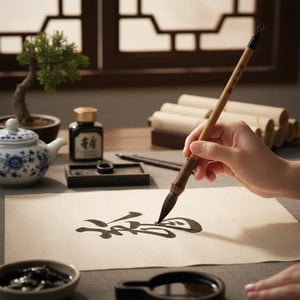
The Quiet Discipline of the Brush
Mianyi lived during the Qing dynasty, a period of profound scholarly activity in China. Born in 1764, this individual dedicated a life to the meticulous practice of calligraphy. The work was not about grand gestures or sweeping landscapes, but rather the disciplined, rhythmic movement of ink on paper. In the quiet moments of creation, Mianyi sought to capture the essence of ancient inscriptions, translating the stone-carved characters of the past into the fluid, living language of ink.
The practice of calligraphy requires a specific kind of patience. It is a medium where every stroke is permanent, leaving no room for hesitation. Mianyi’s hand moved with a sense of purpose, often working on albums of leaves that allowed for a sequential, intimate viewing experience. These works were not meant for vast halls, but for the close, personal study of those who understood the weight of a single line.
A Legacy in Ink and Stone
Much of the surviving evidence of Mianyi's skill comes from the way others interacted with the work. The art of calligraphy is often a communal experience, where scholars add their own thoughts through colophons and seals. Through these additions, we see how Mianyi's hand connected with the intellectual circles of the time.
- The use of ink on paper to replicate ancient stone inscriptions.
- The creation of albums containing multiple leaves for sequential study.
- The practice of signing and sealing works to mark authorship and ownership.
- The tradition of receiving colophons from contemporary scholars.
The physical presence of these works often includes the marks of many hands. Seals pressed into the paper serve as a map of the work's history, showing where it has traveled and whose eyes have rested upon it. These marks, alongside the artist's own signature, turn a piece of paper into a historical record of scholarly appreciation.
The Weight of Tradition
Mianyi's focus remained steadfastly on the preservation of form. By imitating the styles of earlier eras, such as the Tang or Song dynasties, the artist helped maintain a bridge between the ancient past and the present. This was not mere imitation, but a deep engagement with the structural integrity of the characters. The work required a profound understanding of how ink behaves when it meets the fibers of the paper, a skill honed through years of repetitive, meditative practice.
By the time of death in 1815, Mianyi had contributed to a long lineage of calligraphers who valued clarity and strength over ornamentation. The surviving pieces, held in collections such as The Palace Museum in Beijing, remain as evidence of a life spent mastering the subtle complexities of the brush. Each stroke remains a quiet echo of a scholar's devotion to the written word.
Perguntas e Respostas
Existe uma cronologia da carreira de Mianyi?
Um relato cronológico da obra de Mianyi está disponível na página Linha do tempo do artista, onde as obras são apresentadas em ordem de criação, capítulo por capítulo.
Posso navegar pelas obras de Mianyi por movimento?
A página Todos os Movimentos agrupa as obras de Mianyi por movimento artístico.
Posso navegar pelas obras de Mianyi por paleta de cores?
Para encontrar obras de Mianyi em uma paleta específica, acesse a página de Por paleta de cores do artista.
Posso ordenar as obras de Mianyi por cor?
O Índice de Cores de Mianyi organiza as obras do artista por cores.