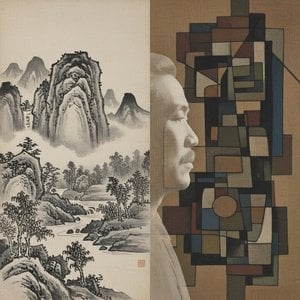
A Pioneer of Korean Avant-Garde: Kim Ku-lim’s Exploration Beyond Convention
Kim Ku-lim (김구림), born in Sangju, South Korea in 1936, stands as a singular figure in Korean art history – the nation's inaugural champion of avant-garde experimentation. Rejecting established artistic norms from his formative years amidst Seoul’s burgeoning experimental scene during the late 1960s and early 1970s, he embarked on a multifaceted artistic journey that spanned film, light sculpture, performance art, and crucially, land art, establishing him as a visionary ahead of his time. Exposure to Japan's artistic landscape in the mid-1970s further broadened his horizons and instilled within him a profound appreciation for Eastern philosophical concepts, particularly Yin and Yang – principles that would become central to his ongoing creative exploration.
Early Influences & Seoul’s Experimental Spirit: Ku-lim's artistic genesis coincided with Korea’s intellectual ferment. He absorbed the ideas of Surrealism and Fluxus, reacting against formalism and embracing spontaneity and chance as tools for artistic expression.
Transnational Engagement & Conceptual Art: Moving to the United States in 1984 solidified his connection to international art discourse. This period fueled his engagement with conceptual art, prioritizing ideas over visual aesthetics and challenging viewers to contemplate broader societal concerns.
Land Art & Performance – Embracing Nature’s Rhythm: Ku-lim's distinctive style found its expression in land art projects—large-scale interventions that responded directly to the environment. Simultaneously, his performance pieces explored themes of ritual and transformation, mirroring the cyclical nature of Yin and Yang.
Diverse Media & Persistent Innovation: Throughout his career, Ku-lim consistently pushed boundaries across various mediums – film, sculpture, installation art—demonstrating an unwavering commitment to artistic innovation. He never adhered to stylistic trends but rather pursued a singular vision rooted in Eastern philosophy.
His work garnered considerable acclaim internationally and cemented his reputation as Korea’s foremost avant-garde artist. Notable achievements include the creation of monumental sculptures that engage with geological formations, immersive film installations exploring psychological landscapes, and performance pieces designed to provoke contemplation on human existence. Kim Ku-lim's legacy resides not merely in his artistic output but also in his role as a catalyst for Korean art’s evolution—a figure who dared to question convention and champion the transformative potential of experimental practice. He continues to create today, embodying the spirit of relentless curiosity and artistic exploration that defines his extraordinary career.
Notable Works & Artistic Style
Among Ku-lim's most celebrated pieces are “From Phenomenon to Traces,” a striking documentary photograph capturing an arid landscape alongside an earthen dam—a testament to his masterful use of earthy tones and dramatic lighting to evoke profound contemplation. Similarly, "Art of Incomprehensibility" showcases his sculptural explorations of form and materiality, reflecting the influence of Zen Buddhism’s emphasis on simplicity and direct experience. His film installations delve into psychological realms, utilizing innovative techniques to convey complex emotions and ideas. These projects exemplify Ku-lim's signature style: characterized by a deliberate rejection of traditional aesthetics in favor of conceptual rigor and an unwavering engagement with natural elements—a reflection of the core tenets of Yin and Yang.
Explore the captivating world of Yi Eungro (Lee Ungno), a pivotal figure in Korean modernism. Discover his unique fusion of Eastern and Western artistic traditions, abstract masterpieces, and lasting legacy. A must-read for discerning art collectors.
Explore the profound beauty of Japanese landscape painting. From Hokusai's iconic vistas to Zen-inspired compositions, discover the spiritual depth and historical mastery of Ukiyo-e art in this expert cultural retrospective.
Existe uma linha do tempo das obras de Kim Ku-lim?
As obras de Kim Ku-lim podem ser visualizadas em ordem cronológica na página de Linha do tempo das obras do artista.
A qual período histórico pertence a obra de Kim Ku-lim?
Kim Ku-lim atuou no período Modern. Este período situa a atividade do artista na história.
Onde posso explorar as obras de Kim Ku-lim mapeadas por tema?
As obras de Kim Ku-lim podem ser exploradas por tema na página Atlas de Temas do artista.
Posso navegar pelas obras de Kim Ku-lim por paleta de cores?
As obras de Kim Ku-lim podem ser exploradas por paleta de cores na página de Por paleta de cores do artista.
Onde e quando nasceu Kim Ku-lim?
Kim Ku-lim nasceu em Sangju, em 1936.
Existe um tour virtual 3D das obras de Kim Ku-lim?
É possível fazer uma visita virtual: a página Galeria 3D de Kim Ku-lim apresenta as obras do artista em uma galeria tridimensional.
Posso navegar pelas obras de Kim Ku-lim por técnica?
As obras de Kim Ku-lim podem ser exploradas por técnica na página de Por Técnica do artista.
Posso estudar o uso de cores de Kim Ku-lim em todas as suas obras?
O DNA da Paleta de Kim Ku-lim apresenta o perfil cromático da obra do artista.
Existe uma cronologia da carreira de Kim Ku-lim?
Um relato cronológico da obra de Kim Ku-lim está disponível na página Linha do tempo do artista, onde as obras são apresentadas em ordem de criação, capítulo por capítulo.