Kim Ho Deuk: A Journey Through Korean Ink Landscape
Kim Ho Deuk, born in Daegu, South Korea in 1950, stands as a prominent figure in contemporary Korean ink painting—a tradition deeply rooted in Buddhist philosophy and artistic expression. His formative years were marked by rigorous academic pursuits at Seoul National University’s College of Fine Arts, culminating in degrees in both B.F.A. and M.F.A., specializing in painting. This grounding in classical techniques profoundly shaped his artistic vision, informing a lifelong dedication to exploring the profound symbolism inherent within landscape imagery. Early Influences: Ho Deuk’s artistic sensibilities were nurtured by exposure to Zen Buddhism and its emphasis on mindfulness and contemplation—influences that permeate his oeuvre. The teachings of Zen masters resonated deeply with him, fostering an appreciation for simplicity, emptiness, and the interconnectedness of all things – concepts central to Buddhist cosmology which would become recurring themes in his artwork. Formal Training: His studies at Seoul National University provided him with a comprehensive understanding of Western art history alongside Korean painting traditions, fostering a balanced perspective on artistic innovation. He diligently studied the works of Impressionists and Expressionists alongside masters of Korean calligraphy and landscape painting—a deliberate effort to synthesize diverse aesthetic approaches. This dual influence shaped his artistic sensibility, equipping him with both technical proficiency and intellectual curiosity. Notable Exhibitions: Recognizing his talent early on, galleries like Hakgojae and Gallery BK championed his work, showcasing solo exhibitions that garnered critical acclaim and establishing him as a respected artist within Korea’s art community. These exhibitions solidified his reputation as a visionary innovator—a pioneer of Korean ink painting who dared to challenge conventions and explore uncharted artistic territory. Specifically, his debut exhibition at Hakgojae in 1985 established him as a significant voice in the burgeoning Korean art scene.The Essence of Korean Ink Landscape Painting
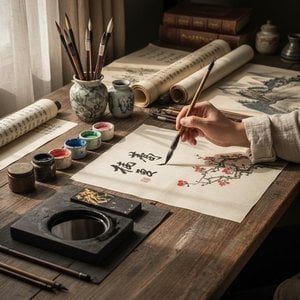
At the core of Kim Ho Deuk's artistic practice lies the meticulous execution of ink wash painting—a technique characterized by its deliberate simplicity and profound expressive power. Unlike Western landscape paintings that strive for realistic representation, Korean ink landscapes prioritize conveying emotion and spiritual insight rather than visual accuracy. The artist employs subtle gradations of tone achieved through layering washes of ink onto rice paper, creating textures that mimic the natural world while simultaneously embodying concepts of emptiness (sunyata) and interconnectedness—themes central to Buddhist cosmology. Technique: Ho Deuk’s mastery lies in mastering the delicate balance between spontaneity and control—a hallmark of Korean ink painting tradition. He utilizes a technique known as *Ma*, which translates roughly to “negative space”—leaving areas of blank paper untouched to create visual tension and invite contemplation about the relationship between form and void. This approach reflects Zen Buddhist principles, emphasizing that true beauty resides not in filling every available space but in allowing emptiness to illuminate what is present. Symbolism: Recurring motifs such as mountains, trees, and rocks are imbued with symbolic significance, representing permanence, resilience, and the cyclical nature of existence. Each brushstroke carries a deliberate intention—a conscious effort to communicate profound ideas about the human condition and our place within the universe. The artist’s meticulous attention to detail underscores his commitment to conveying not merely what is seen but what is felt—the underlying essence of experience itself.Exploring Conceptual Depth Through Landscape Imagery
Kim Ho Deuk distinguishes himself from many contemporary artists by embracing a conceptual approach to landscape painting—a departure from purely descriptive representations. Drawing inspiration from Zen Buddhist texts like the Linji Lu, he seeks to capture not merely what is seen but what is felt—the underlying essence of experience itself. As expressed in the Linji Lu, “One must distinguish black and white in a split second and determine life and death in a flash of lightning,” Ho Deuk’s paintings reflect this preoccupation with immediacy and transformative insight. Zen Influence: The concept of "now"—a state of pure presence—serves as a guiding principle for his artistic process, mirroring the Zen ideal of achieving enlightenment through mindfulness. He strives to capture the fleeting beauty of nature—the ephemeral moment when sunlight illuminates a dewdrop or when wind rustles through leaves—recognizing that true understanding arises from embracing impermanence and accepting the limitations of rational thought. Gestalt Psychology: He utilizes Gestalt principles to create visual compositions that emphasize relationships between elements—demonstrating an awareness of perceptual psychology and its impact on artistic interpretation. Like Kosuth’s “One and Three Chairs,” Ho Deuk's work engages in a dialogue with philosophical concepts, prompting viewers to consider questions of perception, reality, and the human condition. Recognition and Legacy: Kim Ho Deuk’s artistic achievements have been recognized internationally through prestigious art fairs such as Art Basel Hong Kong and Ink Studio—solidifying his position as a leading voice in Korean contemporary art. His representation by Hakgojae Gallery ensures continued visibility for his work and contributes to the preservation of Korean ink painting traditions for future generations. Ultimately, Kim Ho Deuk’s enduring contribution lies in his ability to transform landscape imagery into vehicles for profound spiritual contemplation—a testament to the transformative power of artistic expression.Perguntas e Respostas
Onde as obras de Kim Ho Deuk estão agrupadas por palavras-chave?
As obras de Kim Ho Deuk podem ser exploradas por palavra-chave na página de Por Palavras-chave do artista. Cada palavra-chave agrupa as obras relacionadas.
Onde estão as obras de Kim Ho Deuk mapeadas por tema?
As obras de Kim Ho Deuk podem ser exploradas por tema na página Atlas de Temas do artista.
Que sentimentos as obras de Kim Ho Deuk expressam?
As obras de Kim Ho Deuk podem ser exploradas por humor na página Sala de Humor do artista, que organiza as obras de arte de acordo com seus humores registrados.
Como posso ver todas as obras criadas por Kim Ho Deuk?
Todas as obras de Kim Ho Deuk no este site podem ser visualizadas na página de Todas as Obras de Arte do artista.
Onde as obras de Kim Ho Deuk estão agrupadas por movimento artístico?
Os movimentos em que Kim Ho Deuk trabalhou podem ser vistos na página de Todos os Movimentos do artista, que agrupa as obras por movimento.
Quantas obras de Kim Ho Deuk estão disponíveis para visualização?
Você pode explorar 1 obra de arte obras de Kim Ho Deuk na página Todas as Obras de Arte.
Existe um relato cronológico de Kim Ho Deuk?
Um relato cronológico da obra de Kim Ho Deuk está disponível na página Crônica do artista, onde as obras de arte passam em ordem de criação, capítulo por capítulo.
Posso navegar pelas obras de Kim Ho Deuk por técnica?
A página Todos os Meios agrupa as obras de Kim Ho Deuk por técnica.