

A pintura que tornou Kaj Ejstrup famoso(a) é Self-Portrait (1932); ela está exposta no Statens Museum For Kunst, em Copenhague. Women Bathing (1938) e Landscape, Odsherred (1942) seguem-lhes nos corações de colecionadores e visitantes de museus. Dos 5 trabalhos de Kaj Ejstrup em nosso catálogo, estas 5 são as obras mais admiradas, cada uma apresentada com a sua data, o seu museu e o que a torna única.
Classificado de acordo com o nosso índice de popularidade, que combina buscas, visitas e pedidos de cada obra. Atualizado em Novembro 2026. Cada obra-prima nesta página pode ser encomendada como uma reprodução em óleo pintada à mão, com qualidade de museu, ou como uma impressão de fine art, no tamanho de sua escolha.


O museu que detém a maioria das pinturas desta página.
| Museus | Cidade | Obras de Kaj Ejstrup | Pinturas desta lista |
|---|---|---|---|
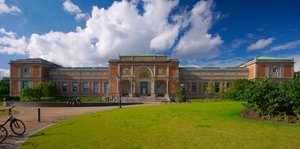 Statens Museum For Kunst |
Copenhague | 5 | Self-Portrait, Women Bathing, Landscape, Odsherred |


Self-Portrait (1932), Statens Museum For Kunst, Copenhague. Seguem-se Women Bathing (1938) e Landscape, Odsherred (1942).
30 anos: Self-Portrait data de 1932 e Kaj Ejstrup nasceu em 1902.
Nosso catálogo lista 5 obras de Kaj Ejstrup, datadas de 1932 a 1955.
A maioria deles está em Statens Museum For Kunst (Copenhague). A tabela acima lista os museus um a um.
Em 1930s: 2 das 5 obras nesta página datam dessa época, entre elas Self-Portrait.
A obra mais antiga nesta página é de Self-Portrait (1932), e a mais recente é de View of Lammefjorden (1955).
Self-Portrait, Women Bathing e Landscape, Odsherred estão entre as 5 obras nesta página pertencentes ao Statens Museum For Kunst, Copenhague.
Sim. Todas as pinturas desta página podem ser encomendadas como uma reprodução em óleo pintada à mão com qualidade de museu ou como uma impressão de fine art, no tamanho de sua escolha, a partir da própria página da pintura.
Kaj Ejstrup was born in 1902, the adopted son of a customs official. His upbringing in Buddinge, just north of Copenhagen, set the stage for a life dedicated to visual expression. Though he did not find a place at the Royal Danish Academy of Fine Arts, his path remained focused on the craft. He spent time between 1931 and 1937 learning the intricacies of wood engraving under Aksel Jørgensen, a period that helped refine his technical skill and eye for detail.
By 1930, he had settled in Åsen near Ordrup in Odsherred. He lived in an old homestead near Skamlebæk until 1944, and even after leaving that specific home, he returned to the Odsherred region for extended periods every year. This connection to the land became the heartbeat of his creative life.
As a central figure in the Odsherred Painters, Ejstrup helped define a specific way of seeing the Danish countryside. His landscapes often capture the quietude of the northwest Zealand region. He frequently painted buildings, outhouses, and farm animals, sometimes including a human figure to ground the scene. His palette in these works remained limited, focusing on the essential colors of the earth and sky. He had a particular talent for depicting horses, often showing them in motion—running or jumping—which added a sense of sudden energy to an otherwise peaceful setting.
His approach changed when he turned his attention to people. While his landscapes were restrained, his figure paintings utilized more vivid colors and an expressive tone. His versatility extended beyond the canvas to include:
Ejstrup was a man of community within the art world, becoming a founding member of the Corner artists association in 1932. His work moved beyond the borders of Denmark, finding its way to galleries in Glasgow, Oslo, and Gothenburg. His contributions to Danish art were recognized in 1954 when he was awarded the Eckersberg Medal.
Today, his visual history is preserved in several important institutions. His paintings, woodcuts, and sculptures can be found in many of Denmark's art museums, including a large collection held at the Statens Museum for Kunst and much of his work housed at the Odsherreds Museum of Art.