The Impressionist Light of Hans von Hayek
Born in the vibrant cultural landscape of Vienna on December 19, 1869, Hans von Hayek emerged as a significant figure within the German Impressionist movement. His early life was steeped in an environment of intellectual and artistic rigor; he was born to Theodor von Hayek and Marie Cäcilie Wittek, coming from a lineage that included notable naturalists and even the famed economist Friedrich Hayek. This rich heritage provided a foundation of curiosity and discipline that would later define his approach to the canvas. After a brief period of formative study at the University of Applied Arts in Vienna, Hayek’s artistic ambitions drew him toward Munich, a city then pulsating with the energy of modern art movements. It was here, amidst the prestigious Academy of Fine Arts, that he began to refine his technical prowess under the guidance of masters such as Gabriel von Hackl and Wilhelm von Lindenschmit.
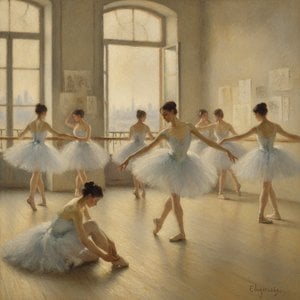
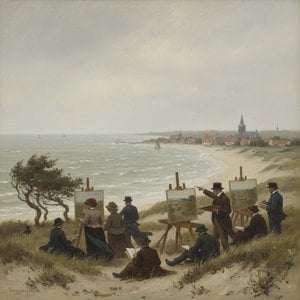
The evolution of Hayek’s style is a testament to the profound impact of mentorship and the pursuit of naturalism. While his academic training provided him with a robust command of structure, it was his encounter with the animal painter Heinrich von Zügel that truly ignited his Impressionist spirit. Under Zügel's influence, Hayek moved away from rigid academicism toward a more fluid, atmospheric technique, focusing on the interplay of light and texture. This transition marked his departure from traditional portraiture and historical subjects toward the capturing of fleeting moments in the natural world. His dedication to plein aire painting—working directly under the open sky—allowed him to observe the subtle shifts in color and light that define the Impressionist aesthetic, a pursuit that would become the cornerstone of his professional identity.
The Dachau Years and Artistic Legacy
In 1900, Hayek sought a more tranquil environment conducive to his creative vision, eventually settling in the renowned artists' colony of Dachau. This period proved to be perhaps the most prolific and influential chapter of his life. Not only did he establish himself as a master of the landscape, but he also became a pivotal educator, founding a private school dedicated to the art of painting outdoors. His academy became a sanctuary for aspiring talents, including artists such as Hugo Hatzler and Anna Klein, who sought to learn his methods of capturing light and atmosphere. The presence of Hayek’s school was so significant that local legends tell of farmers complaining about students inadvertently trampling the very meadows they were so intently trying to immortalize on canvas.
Beyond his role as a teacher, Hayek was an active participant in the broader European art scene. His involvement with the Munich Secession and his exhibitions with the Deutscher Künstlerbund solidified his standing among the contemporary elite. His travels took him far beyond the borders of Germany, through Western and Northern Europe, and even to the exotic landscapes of Indonesia and Ceylon, each journey enriching his palette with new perspectives on light and form. However, the history of his work is also marked by profound tragedy. The devastating fire at the Munich Glaspalast in 1931, along with the aerial bombardments of 1945 that destroyed his studio, resulted in the heartbreaking loss of many of his masterpieces.
Despite these losses, the enduring legacy of Hans von Hayek remains preserved through the surviving works held in esteemed institutions like the Gemäldegalerie Dachau. His contribution to art lies not only in the beauty of his landscapes but in his role as a bridge between academic tradition and the modern Impressionist movement. He remains a celebrated figure whose work continues to evoke the serene, sun-drenched moments of a bygone era, reminding us of the delicate balance between the artist's hand and the natural world.
Perguntas e Respostas
Onde posso explorar as obras de Hans von Hayek mapeadas por tema?
O Atlas de Temas de Hans von Hayek é uma página que mapeia as obras do artista por seus temas.
Posso navegar pelas obras de Hans von Hayek por movimento?
Os movimentos em que Hans von Hayek atuou podem ser conferidos na página de Todos os Movimentos do artista, que agrupa as obras por movimento.
Onde e quando nasceu Hans von Hayek?
Hans von Hayek nasceu em Vienna, em 1869.