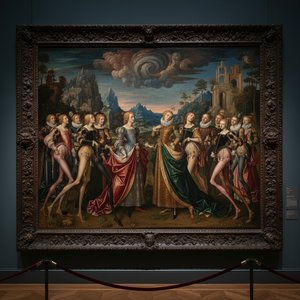
The Architect of Emotion: The Life and Legacy of Girolamo Genga
Girolamo Genga stands as a pivotal figure in the late Renaissance artistic landscape, particularly renowned for his masterful command of Mannerism—a style characterized by stylized forms, exaggerated perspective, and an emphasis on emotional intensity. Born in the illustrious city of Urbino, Italy, around 1476, Genga’s formative years were steeped in the intellectual fervor of Federico da Montefeltro's court. This was a crucible where humanist ideals intersected with artistic innovation, providing a fertile ground for a young talent to flourish. His early apprenticeship under the legendary Luca Signorelli instilled within him a foundational understanding of sculptural realism and narrative storytelling, skills that would serve as the bedrock of his prolific career. As his journey unfolded, Genga moved through the most vibrant artistic centers of Italy, honing his craft alongside titans such as Pietro Perugino and Raphael in Umbria. This exposure to Raphael's harmonious compositions undoubtedly influenced Genga’s aesthetic sensibilities, fostering a lifelong desire for elegance and balance while simultaneously nurturing an inclination towards dramatic visual effects. His subsequent ventures into Florence and Siena cemented his reputation as a versatile artist capable of adapting to diverse commissions and complex artistic traditions. One notable achievement was his collaboration with Timoteo della Vite on the opulent decoration of Pandolfo Petrucci’s palazzo in Siena, a project that perfectly exemplifies Genga's ability to synthesize classical ideals with contemporary stylistic trends.Theatricality and the Mastery of Space
Returning to his roots in Urbino, Genga became a favored artist of Duke Guidobaldo da Montefeltro. It was during this period that his unique talent for large-scale, immersive environments truly began to shine. He undertook monumental commissions for the ducal palace and famously orchestrated the elaborate staging of Guidobaldo’s funeral procession in 1508. This particular commission served as a testament to his theatrical flair and technical prowess, underscoring an exceptional ability to design spaces that conveyed profound emotional resonance and grandeur. His work often transcended the boundaries of mere painting, merging the roles of painter and architect to create unified aesthetic experiences. His contributions to the Villa Imperiale and various architectural endeavors demonstrate a mind that viewed art not as isolated objects, but as integral components of a larger, lived environment. Through his frescoes and altarpieces, Genga breathed life into stone and plaster, using light, shadow, and movement to guide the viewer's eye through complex theological and mythological narratives.A Lasting Impression on the Mannerist Movement
The historical significance of Girolamo Genga lies in his role as a bridge between the balanced perfection of the High Renaissance and the expressive, often turbulent energy of Mannerism. By embracing the more artificial and stylized elements of art, he helped pave the way for future generations to explore the psychological depths of their subjects. His legacy is found in:- The Synthesis of Styles: His ability to blend the sculptural weight of Signorelli with the grace of Raphael.
- Architectural Integration: The seamless marriage of decorative painting with structural design, particularly in his work for the Italian nobility.
- Narrative Drama: The use of theatrical staging and perspective to evoke intense emotional responses from the spectator.
Perguntas e Respostas
Quais obras de Girolamo Genga são as mais visualizadas?
As estatísticas sobre as obras de Girolamo Genga estão disponíveis na página de Estatísticas do artista.
Onde posso ver o perfil de cores da obra de Girolamo Genga?
O perfil de cores da obra de Girolamo Genga pode ser visualizado na página DNA da Paleta do artista.
Como posso acompanhar a obra de Girolamo Genga ano após ano?
A página de Linha do tempo das obras do artista apresenta as obras de Girolamo Genga ordenadas por data, ano a ano.