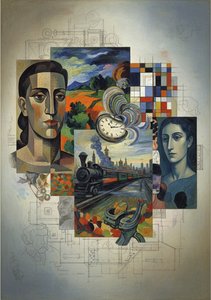
The Architect of Dreams: The Life and Legacy of Bruno Schulz
In the narrow, winding streets of Drohobych, a small Galician town once nestled within the Austro-Hungarian Empire, there existed a world where the boundaries between reality and myth were perpetually blurred. It was here that Bruno Schulz was born in 1892, a place he would view as the very center of the universe. A Polish Jewish writer, fine artist, and literary critic, Schulz did not merely observe his surroundings; he reimagined them through a lens of profound, hallucinatory beauty. His life, though tragically truncated by the violence of the Holocaust, remains a testament to the power of the imagination to transcend the physical constraints of existence.
Schulz’s early years were steeped in the textures of his provincial home. The son of a fabric shop owner and a woman whose family managed a local sawmill, he grew up amidst the sensory richness of a bustling market town. While he initially pursued studies in architecture at the Polytechnic in Lulow, a bout of illness forced him to return to Drohobych. This redirection proved serendipitous, as it allowed him to become an acute chronicler of his native soil. His artistic development was deeply intertwined with his surroundings; he saw the mundane—a dusty street, a merchant’s shop, or a family heirloom—as something capable of metamorphosis into the magical and the eternal.
A Prose of Metamorphosis and Myth
As a writer, Schulz achieved a level of stylistic mastery that placed him among the most significant prose stylists of the 20th century. His literary output, though relatively modest in volume, is unparalleled in its depth and linguistic complexity. In his celebrated short story collections, The Street of Crocodiles and The Sanatorium Under the Sign of the Hourglass, he weaves a tapestry of "mythologized reality." His prose does not merely describe events; it captures the mental impressions of yearning, dreaming, and the fluid nature of time itself. He utilized language to create a dreamlike vision where the line between life and death, or the real and the imaginary, becomes almost imperceptible.
His work is characterized by several defining elements:
- The Concept of Mythologization: The ability to elevate everyday provincial life into the realm of epic, cosmic significance.
- Linguistic Richness: A dense, metaphorical style that uses colorful language to evoke a sense of wonder and disorientation.
- Temporal Fluidity: A fascination with "loops of past time," where memory and childhood dreams intersect with the present moment.
- Visual Sensibility: As an artist and illustrator, his writing possesses a tactile, painterly quality that brings the textures of his world to life.
The Tragic Eclipse of a Visionary
The brilliance of Schulz’s creative spirit was met with the darkest chapter of human history. As the Nazi occupation descended upon Poland, the vibrant, multicultural world of the Galician shtetl began to vanish. The very streets he had immortalized in his prose became sites of unimaginable horror. In 1942, while walking toward the Drohobych Ghetto with a simple loaf of bread, Schulz was shot and killed by a Gestapo officer. His death was not only a personal tragedy but a profound loss to global culture, as much of his recent work and unfinished manuscripts, including his final novel The Messiah, were lost to the flames of the Holocaust.
Despite this attempt to erase his existence, Schulz’s influence has experienced a powerful resurrection. His literary and visual echoes can be found in the works of modern masters such as Cynthia Ozick, Philip Roth, and David Grossman. Even the cinematic world has paid homage to his vision, most notably through the haunting puppet animations of the Quay Brothers and the surrealist films of Wojciech Jerzy Has. Today, Bruno Schulz is remembered not merely as a victim of history, but as an architect of dreams whose evocative art continues to haunt and inspire the collective human imagination.
Perguntas e Respostas
Onde as obras de Bruno Schulz estão agrupadas por palavras-chave?
A página Por palavras-chave de Bruno Schulz agrupa as obras do artista por palavras-chave.
Existe uma visão geral de todos os temas que Bruno Schulz pintou?
A página Atlas de Temas mapeia as obras de Bruno Schulz por tema.
Onde posso ver as obras de Bruno Schulz em uma galeria 3D?
A Galeria 3D de Bruno Schulz é uma página que apresenta as obras do artista em uma galeria virtual tridimensional.