
1813 - 1876

Informações rápidas

  • Copyright status: Public domain
  • Top 3 works:
    • Mountain Landscape with the Wiesbachhorn
    • Wengeralpe in the Berner Oberland (Jungfrau and Mönch)
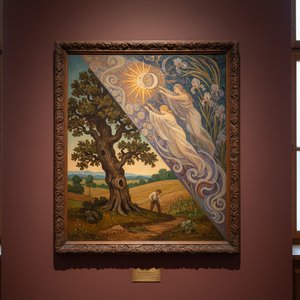
    • landscape: river-valley in the mountains + 3 woman
  • Color intensity: monochromatic
  • Died: 1876
  • Born: 1813, Vienna, Austria
  • Art period: 19th Century

The Life and Art of Anton Hansch

Born in Vienna, Austria, Anton Hansch began his journey in a family that operated a factory for artificial flowers. This early environment served as his training before he attended the Vienna Academy to become a flower painter. Between 1826 and 1836, he studied under Josef Mössmer. Before transitioning into a landscape painter, he spent time making artificial flowers. His artistic evolution saw him move from a baroque classicist style in his early landscapes toward a more naturalistic tradition, which eventually developed into an idealized, heroic style.

Hansch's travels took him through Germany, Austria, Belgium, Switzerland, and Italy. His mastery of the landscape was recognized through various honors, including the Grand Court Prize and the Rosenbaum Composition Prize. In 1839, he was awarded first prize for landscape painting by the Vienna Academy. His work has been held in prestigious collections, such as the Kunsthistorisches Museum, the Museum of Fine Arts, Budapest, the Salzberg Museum, the Lichtenstein Museum Princely Collection, and the Vienna Museum.

Later Years and Legacy

Throughout his career, Hansch received numerous accolades, including an appointment to the Academy of Fine Arts in 1848 and becoming a member of the Vienna Künstlerhaus in 1861. His talent was noted by royalty; for instance, a painting of a night scene titled Unter den Linden won a purchase prize by the Belvedere in Vienna, and a work depicting Lake Langbath was presented as a gift to the Emperor Franz Josef. He was also awarded the Knight's Cross of the Franz Josef Order and the Order of Guadalupe prize from Emperor Maximillian I of Mexico.

Following a financial crisis during the Panic of 1873, Hansch settled in Salzburg in 1875, where he focused on the surrounding landscapes, including the Golling waterfall, Berchtesgaden, Königssee, and Chiemsee lake. In his final years, as his eyesight began to fail, he remained active in the region until his death in Salzburg.
Teste o seu olhar

Cada pergunta possui apenas uma resposta correta.

Pergunta 1:
In which city was Anton Hansch born?
Pergunta 2:
Before becoming a landscape painter, what did Hansch make?
Pergunta 3:
Which institution did Hansch attend as a pupil from 1826–1836?
Pergunta 4:
What event in 1873 caused Hansch to lose his fortune?
Pergunta 5:
In which city did Anton Hansch die?

Perguntas e Respostas

Onde as obras de Anton Hansch estão agrupadas por movimento artístico?

As obras de Anton Hansch podem ser exploradas por movimento na página de Todos os Movimentos do artista.

Por quais outros nomes ou pseudônimos Anton Hansch é conhecido?

Anton Hansch também é conhecido pelos nomes Hantsch Anton, Hansch, A. Hansch, Hansch Anton.

Posso navegar pelas obras de Anton Hansch por humor?

A Coleção por Humor de Anton Hansch organiza as obras do artista por humor.

Posso ordenar as obras de Anton Hansch por cor?

A página Índice de Cores organiza as obras de Anton Hansch por cor.

Onde e quando nasceu Anton Hansch?

Anton Hansch nasceu em Vienna, em 1813.

Posso visitar um museu virtual das obras de Anton Hansch?

As obras de Anton Hansch podem ser visualizadas em uma galeria 3D na página Galeria 3D do artista.

Onde posso encontrar as obras de Anton Hansch agrupadas por paleta?

A página Por paleta de cores agrupa as obras de Anton Hansch por suas paletas de cores.

Existe uma linha do tempo das obras de Anton Hansch?

As obras de Anton Hansch podem ser visualizadas em ordem cronológica na página de Linha do tempo das obras do artista.

Como a arte de Anton Hansch evoluiu ao longo do tempo?

Um relato cronológico da obra de Anton Hansch está disponível na página Linha do tempo do artista, onde as obras são apresentadas em ordem de criação, capítulo por capítulo.