A Life Between Brussels and London
André Edmond Alfred Cluysenaar entered the world in Saint-Gilles, Brussels, on 31 May 1872, born into a lineage where art was an inheritance. As the son of the historical painter Alfred Cluysenaar, his early education was shaped by the heavy influence of his father’s hand and the formal training of François-Joseph Navez. His initial forays into the arts were not limited to the brush; in 1897, he briefly explored sculpture, exhibiting a work titled Saint Sebastian. However, the weight of the canvas eventually became his true calling.
The trajectory of his life was irrevocably altered by the onset of the First World War. Following the German invasion of Belgium, Cluysenaar joined a large community of displaced Belgian artists fleeing to London. This period of exile transformed him from a painter of the Belgian elite into a figure integrated within the British art scene. While he found refuge in the United Kingdom, his work remained deeply connected to the political and emotional realities of his homeland.
The Evolution of Style and Subject
Cluysenaar’s early output was rooted in the traditions of Romanticism, focusing on religious subjects, historical scenes, and still lifes. His style possessed a certain formal elegance, yet it was never static. Over time, he moved away from rigid structures toward a more impressionistic approach. This shift brought with it a looser handling of paint and a focus on chromatic subtlety. He became particularly noted for his depictions of women, often rendered with a soft luminosity and a sense of sensual softness that drew heavily from the influence of Alfred Stevens.
His portraiture became a hallmark of his career in London. He possessed a particular talent for capturing high society figures with a psychological intensity that went beyond mere surface charm. His subjects included notable political leaders such as:
- Prime Minister Herbert Asquith
- Lord Balfour
- David Lloyd George
- Émile Vandervelde
Artistry Amidst Conflict
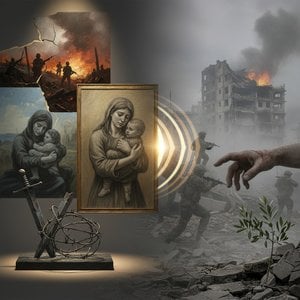
The war years demanded a different kind of expression from Cluysenaar. His 1917 painting, Britannia with Belgian Refugees, remains one of his most significant historical contributions. In this work, he utilized maternal allegory to communicate the suffering of civilians, presenting a seated Britannia sheltering a weary mother and child against a backdrop of burning towns. The painting, now held in the Leicester Museum & Art Gallery, serves as a record of the solidarity felt between the displaced Belgians and their British hosts.
Even as his themes shifted toward the political, Cluysenaar continued to find beauty in the quietude of landscapes, nudes, and still lifes. His later years were marked by a lyrical atmosphere and a fresh approach to color. He passed away in Uccle, Brussels, on 7 April 1939, leaving behind a body of work that bridged the gap between the formal traditions of his Belgian upbringing and the fluid, modern sensibilities of his London exile.
Perguntas e Respostas
A qual período histórico pertence a obra de André Cluysenaar?
André Cluysenaar atuou no período Modern. Este período situa a atividade do artista na história.
Onde e quando nasceu André Cluysenaar?
André Cluysenaar nasceu em Saint-Gilles, em 1872.
Existe um tour virtual 3D das obras de André Cluysenaar?
A Galeria 3D de André Cluysenaar é uma página que apresenta as obras do artista em uma galeria virtual tridimensional.
Como a arte de André Cluysenaar evoluiu ao longo do tempo?
Um relato cronológico da obra de André Cluysenaar está disponível na página Linha do tempo do artista, onde as obras são apresentadas em ordem de criação, capítulo por capítulo.