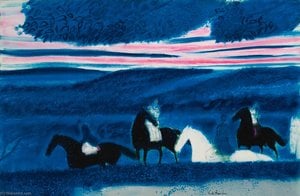
André Brasilier: A Visionary Painter Bridging Impressionism and Surrealism
André Brasilier (born October 29, 1929) stands as a singular figure in French art history—a painter who seamlessly blended the lyrical spirit of Impressionism with the dreamlike explorations characteristic of Surrealist aesthetics. Born into an artistic lineage in Tournon-sur-Rhône to parents deeply immersed in painting, Brasilier’s formative years instilled within him an unwavering appreciation for beauty and a profound connection to the natural world—influences that would permeate his entire oeuvre. He pursued formal training at the École des Beaux-Arts in Paris, honing his skills and establishing himself as a respected artist before gaining international recognition through exhibitions and critical acclaim.
- Early Influences: Brasilier’s artistic journey began under the mentorship of Eugène Boudin and Gustave Moreau, whose landscapes and depictions of biblical scenes profoundly impacted his stylistic sensibilities. These formative experiences instilled in him a fascination with capturing fleeting moments of light and color—a hallmark of Impressionist technique—while simultaneously nurturing an imaginative vision rooted in symbolism and psychological depth.
- The Prix Blumenthal & Rome Prize: In 1952, Brasilier secured the prestigious Prix Blumenthal Award, recognizing his artistic talent and furthering his academic pursuits. The following year, he achieved another monumental accomplishment by winning the Premier Grand Prix de Rome—a competition that allowed him to reside in Italy and immerse himself in the legacy of the Old Masters, specifically Rembrandt and Michelangelo—further enriching his artistic understanding and expanding his creative horizons.
- Surrealist Exploration & Artistic Style: Brasilier’s engagement with Surrealism marked a pivotal moment in his artistic evolution. Inspired by Pablo Picasso and André Derain, he embraced techniques that prioritized spontaneity and subconscious expression—drawing upon automatism and dream imagery to convey profound emotional truths. His canvases often depict serene rural landscapes bathed in soft pastel hues, reflecting the influence of Japanese prints and embodying a harmonious blend of Impressionist lyricism and Surrealist imagination.
Key Themes & Recurring Motifs
Brasilier’s artistic vision consistently centered around exploring themes of nature—particularly horses—and human emotion. Horses served as a central motif throughout his career, symbolizing vitality, freedom, and strength—qualities that resonated deeply with his aesthetic sensibilities. He meticulously rendered these animals in both static and dynamic poses, capturing their essence with bold brushstrokes and conveying a palpable sense of movement. Beyond equine imagery, Brasilier frequently depicted women—often portrayed as muses—capturing their grace and beauty within dreamlike settings—a stylistic hallmark that distinguishes him from many contemporaries. His canvases are imbued with an ethereal quality—characterized by diffused light and subtle color harmonies—reflecting his unwavering devotion to capturing the sublime splendor of the natural world.
- Horses: Brasilier’s fascination with horses stemmed from a childhood encounter with a magnificent stallion, which ignited his imagination and instilled in him an enduring appreciation for animal symbolism.
- Women & Muse: Chantal Brasilier—his wife and lifelong collaborator—served as a constant source of inspiration for André Brasilier, appearing frequently in his paintings as a serene embodiment of feminine beauty and grace.
Notable Achievements & Recognition
Throughout his prolific artistic career, André Brasilier garnered widespread acclaim and achieved remarkable success—establishing himself as one of the last surviving modernist painters of the École des Beaux-Arts. His work was honored with over 100 solo exhibitions across Europe and North America, showcasing his distinctive style and cementing his place among the foremost artists of his generation. He received numerous awards for his contributions to contemporary art—including the Prix Blumenthal Award and the Premier Grand Prix de Rome—demonstrating his unwavering dedication to artistic excellence. Furthermore, Brasilier’s retrospective exhibitions at prestigious institutions such as the State Hermitage Museum in St Petersburg and the Museum Haus Ludwig für Kunstausstellungen Saarlois captivated audiences worldwide—solidifying his legacy as a visionary painter whose oeuvre continues to inspire admiration and scholarly inquiry. His paintings are held in prominent collections globally, including the Metropolitan Museum of Art in New York—a testament to their enduring artistic merit.
Legacy & Artistic Influence
André Brasilier’s artistic legacy extends far beyond his individual creations—leaving an indelible mark on the landscape painting tradition and influencing generations of artists who followed him. His masterful technique—characterized by bold brushstrokes, luminous color palettes, and a harmonious blend of Impressionist lyricism and Surrealist imagination—continues to inspire practitioners today. Brasilier’s unwavering commitment to capturing the sublime beauty of nature—expressed through evocative imagery and dreamlike compositions—remains a cornerstone of modern art history—affirming his status as a true innovator and a singular voice within the artistic discourse of his time.