China Diary, No.54: A Symphony of Strength and Symbolism
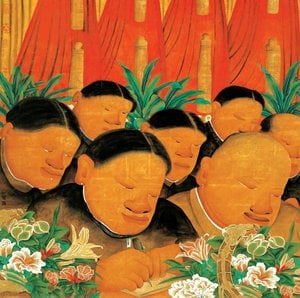
Zhu Wei’s “China Diary, No.54” is more than just a depiction of a bull; it's an immersion into the heart of Chinese artistic tradition, rendered with a contemporary sensibility that speaks volumes about its time. Measuring 194 x 193 cm, this large-scale artwork immediately commands attention with its bold color palette – vibrant greens juxtaposed against meticulously crafted details of a powerfully rendered bull. The composition, largely symmetrical and anchored by traditional red seals at each corner, evokes a sense of ancient ritual and deliberate balance, hallmarks of Chinese painting’s enduring legacy.
- Subject Matter: The central figure is a bull, an animal deeply rooted in Chinese symbolism – representing strength, prosperity, and good fortune.
- Style & Technique: Executed in the style of traditional Chinese ink painting, Zhu Wei employs a masterful brush and ink technique, layered with subtle color washes to create depth and texture. The flattened perspective, characteristic of this genre, emphasizes the symbolic weight of the image rather than striving for photographic realism.
The Artist’s Context: Zhu Wei and Post-Tiananmen China
Born in Beijing in 1966, Zhu Wei is a pivotal figure in contemporary Chinese art. His artistic journey began within the People's Liberation Army Art Academy following military service, an experience that shaped his understanding of state-sponsored art – a crucial context for interpreting his work. Emerging from the period following Tiananmen Square, Zhu Wei’s art subtly engages with political and social themes, demonstrating a remarkable continuity with traditional Chinese painting while offering a critical perspective on its historical evolution. The inclusion of seals, integral to Chinese artistic practice, further amplifies this symbolic engagement.
Decoding the Visual Language
The meticulous detail in “China Diary, No.54” is immediately striking. Sharp lines define the bull’s musculature and horns, while rounded forms – its body, legs, and horns – are rendered with a confident hand. The texture achieved through layering and brushwork adds a tactile quality, inviting close observation. The use of color isn't merely decorative; it serves to enhance the symbolic power of the image, drawing attention to key elements and reinforcing the overall impression of strength and tradition. The placement of the red seals, often carrying auspicious meanings, further deepens the artwork’s narrative.
Emotional Impact & Collecting
"China Diary, No.54" transcends a simple representation; it's an evocative piece that speaks to themes of cultural heritage, resilience, and the enduring power of symbolism. This hand-painted reproduction offers a unique opportunity to own a significant work by a leading contemporary Chinese artist, perfect for collectors seeking pieces with historical depth and artistic merit. Its scale makes it ideal for grand spaces, while the vibrant colors and powerful imagery will undoubtedly become a focal point within any interior design scheme.



 Visualizar na parede
 Comprar pintura feita à mão
 Compartilhar
 Compartilhar
 Detalhes

 Baixar imagem
 Semelhantes
 Raio X
 Slideshow
 Estatísticas


 Ler mais






































 A opção de vidro está disponível apenas para tamanhos inferiores a 110 cm