Zhang Zhao: A Master of Running Script in the Qing Dynasty
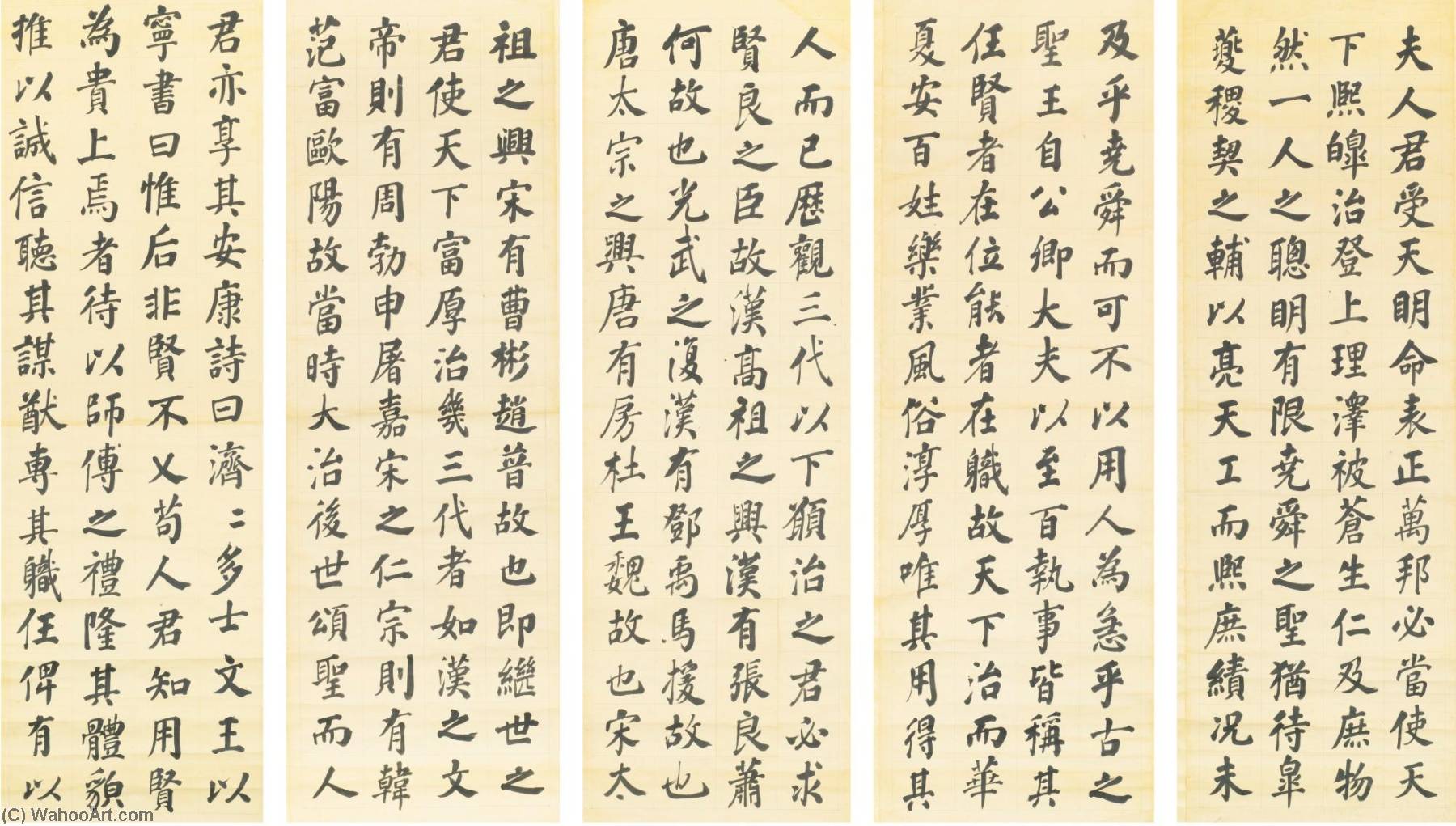
The world of 17th-century Chinese art is rich with figures who shaped its trajectory, and among them stands Zhang Zhao (1691–1745), a calligrapher whose elegant running script – known as *jiejing* – continues to captivate viewers today. More than just a skilled practitioner of brush and ink, Zhang Zhao was a product of his time, deeply influenced by the philosophical currents of the Qing Dynasty and the artistic legacy of Dong Qichang, a pivotal figure in establishing aesthetic standards for Chinese art.
Born in Xu Province during a period of immense political upheaval, Zhang Zhao’s early life instilled within him a profound sense of discipline and an appreciation for scholarship. He initially pursued a career as a civil servant but quickly gravitated towards the refined world of calligraphy, recognizing its power to convey both intellectual depth and aesthetic beauty. His training likely involved studying the works of earlier masters, absorbing their techniques and developing his own distinctive style – one characterized by fluidity, balance, and an almost meditative quality.
The Influence of Dong Qichang
Zhang Zhao’s artistic development was inextricably linked to that of Dong Qichang (1579–1645), a renowned scholar-official and art critic who profoundly shaped the aesthetic landscape of the Qing Dynasty. Dong Qichang championed the concept of *wuhu*, or “five aesthetics”—poetry, music, painting, calligraphy, and ritual—as essential components of a cultivated individual’s life. He advocated for a return to classical forms and values, emphasizing simplicity, sincerity, and a deep connection with nature.
Zhang Zhao was deeply influenced by Dong Qichang's ideas, particularly his emphasis on *jiejing* as a form of refined expression. Dong Qichang’s writings on calligraphy stressed the importance of achieving a state of “naturalness” – a sense of effortless grace and spontaneity – in one’s brushwork. Zhang Zhao embraced this philosophy, striving to capture the essence of his subjects through subtle variations in line weight, pressure, and speed.
A Career in Service and Artistic Recognition
Zhang Zhao's career unfolded within the complex political landscape of the Qing Dynasty. He secured a *jinshi* (successful candidate) position in 1709, demonstrating his intellectual prowess and earning him a place within the imperial bureaucracy. He rose through the ranks, eventually becoming Secretary of the Ministry of Justice in 1733. However, his career was not without its challenges; he narrowly avoided execution after failing to manage aboriginal territories in Guizhou, highlighting the precariousness of life for officials during this turbulent period.
Despite these setbacks, Zhang Zhao continued to produce significant works of calligraphy and poetry. He collaborated with other prominent scholars on important literary projects, including the *Lülü Zhengyi* and its sequel, *Houbian*, which served as standard treatises on music theory. Notably, he was also recognized by the Yongzheng Emperor for his exceptional skill, receiving a commendation for a poem written with his left hand after an accident had impaired his right arm – a testament to his resilience and artistic dedication.
Style and Legacy
Zhang Zhao’s *jiejing* is characterized by its elegant fluidity and subtle variations in line weight. His works often exhibit a sense of quiet contemplation, reflecting the philosophical ideals championed by Dong Qichang. He skillfully employed techniques such as *shougong* (a technique for creating a sense of depth through varying line thickness) and *yanzhuan* (a technique for creating a sense of movement through variations in brush pressure), adding layers of complexity and nuance to his compositions.
While Zhang Zhao’s name may not be as widely recognized as some of his contemporaries, his contributions to the development of running script are undeniable. His works represent a significant example of Qing Dynasty calligraphy, embodying both technical mastery and philosophical depth. Today, his paintings and scrolls continue to be admired for their beauty, elegance, and enduring legacy – a testament to the skill and vision of this remarkable artist.

 Visualizar na parede
 Compartilhar
 Compartilhar
 Detalhes
 Guia
Guia

 Baixar imagem
 Semelhantes
 Raio X
 Ver diaporama
 Perguntas e Respostas
 Estatísticas
 Ler mais
 Alternar para Impressão





































 A opção de vidro está disponível apenas para tamanhos inferiores a 110 cm


