Impressão giclée ou em tela de qualidade de museu, com produção rápida e opções flexíveis de acabamento. ( Comprar pintura feita à mão Comprar imagem)





























Escolha entre os nossos tamanhos pré-definidos que respeitam as proporções originais da obra de arte.

Você pode inserir suas próprias dimensões para se ajustar a uma moldura ou espaço específico. Se o tamanho selecionado não corresponder às proporções da imagem original, iremos recortar a obra de arte ou estender a imagem com uma borda espelhada ou preenchimento sólido. Um mockup digital será enviado para sua aprovação antes do início da produção.
Por favor, observe que a visualização na tela não reflete o recorte ou a extensão real. Apenas o mockup mostrará com precisão a composição final.
Embora tamanhos personalizados estejam disponíveis, recomendamos selecionar uma dimensão da lista predefinida para preservar as proporções originais.
Entrega mundial () em 2 semanas, em vez das 4/5 semanas padrão. (6 Setembro)


Milking Time
Tamanho da Reprodução
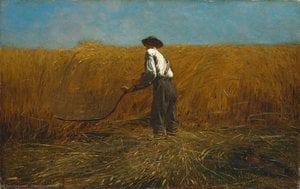
In the quietude of 1875, Winslow Homer captured a moment of profound stillness that continues to resonate with the modern soul. Milking Time is not merely a depiction of agricultural labor; it is an evocative window into the rhythmic, unhurried heartbeat of rural America. As the viewer approaches this masterpiece, they are immediately enveloped by a sense of pastoral serenity. The composition centers on a woman poised beside a rustic fence, her presence anchored by the gentle weight of her cow. This intimate connection between human and beast serves as the emotional anchor of the work, suggesting a life lived in harmonious dialogue with the natural world. Through Homer’s masterful lens, the mundane task of milking is elevated to a state of grace, inviting us to pause and breathe in the tranquility of a bygone era.
The technical brilliance of this oil on canvas lies in Homer's ability to balance structural clarity with atmospheric depth. Using a rich palette that celebrates the earthy tones of the American landscape, he employs texture to bring the scene to life. One can almost feel the rough grain of the wooden fence and the soft warmth of the sunlight filtering through the countryside. The background is a masterclass in perspective; cows are scattered across the distance, some emerging clearly from the periphery while others dissolve into a soft, hazy horizon. This layering creates an expansive sense of space, making the viewer feel as though they are standing right there in the pasture. Even the subtle inclusion of two birds—one perched quietly in the upper corner and another caught in mid-flight above the woman—adds a delicate layer of movement that prevents the stillness from feeling stagnant.
To understand Milking Time, one must look to the historical tapestry of the late 19th century. During this period, as the Industrial Revolution began to reshape the American landscape with iron and steam, Homer turned his gaze toward the enduring dignity of the common man and woman. He was an artist who found beauty in the authentic, eschewing the grandiosity of European academic traditions in favor of a uniquely American realism. This painting serves as a historical document, preserving the quietude of a lifestyle that was already beginning to fade. There is a profound symbolism in the way Homer depicts this connection to the land; it represents a lost innocence and a foundational strength found in the simplicity of nature.
For the discerning collector or the interior designer, this piece offers much more than mere decoration. It provides an emotional anchor for a room, bringing a sense of peace, stability, and timelessness to any space. Whether placed in a sun-drenched morning room or a sophisticated study, a high-quality reproduction of Milking Time acts as a portal to a simpler time. It is an investment in atmosphere, offering a way to infuse contemporary living with the soulful, rugged elegance that only Winslow Homer could provide. To possess this work is to hold a fragment of the American spirit, a reminder that even amidst the chaos of modern life, there remains a profound beauty in the quiet moments of connection and care.


1836 - 1910 , Estados Unidos da América

Explore the profound beauty of American Regionalism. Delve into the art history of Grant Wood and John Steuart Curry, uncovering how these masters captured the soul of the American Heartland through iconic landscapes and rural identity.

 Visualizar na parede
 Compartilhar
 Compartilhar
 Detalhes

 Baixar imagem
 Semelhantes
 Raio X
 Slideshow

 Ler mais







 A opção de vidro está disponível apenas para tamanhos inferiores a 110 cm