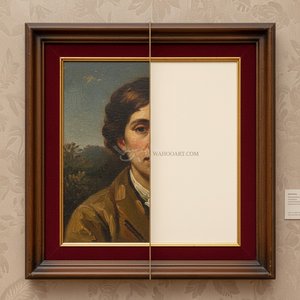
Biografia do Artista
A Life Immersed in Beauty: The World of William-Adolphe Bouguereau
William-Adolphe Bouguereau’s life unfolded within the serene landscapes of La Rochelle, France – a city steeped in maritime history and surrounded by vineyards and olive groves. Born in 1825, his early years were nurtured amidst this idyllic setting, fostering an innate appreciation for beauty and a profound connection to the natural world. From a young age, Bouguereau’s artistic inclinations shone brightly, leading him away from the expected path of commerce and towards the pursuit of art. He received his initial training in La Rochelle, developing a foundational understanding of drawing and composition. However, it was his relocation to Paris and enrollment at the prestigious École des Beaux-Arts that truly ignited his artistic journey. Under the tutelage of François-Edouard Picquenot, Bouguereau honed his skills, absorbing the techniques and philosophies of the Old Masters – particularly the works of Raphael and Titian. These influences weren’t merely imitations; they became the very bedrock upon which he constructed his unique artistic vision: a commitment to meticulous detail, luminous color palettes, and an unwavering dedication to portraying beauty in its most idealized form. Bouguereau wasn't simply replicating what he observed; he was striving to capture an inherent sense of perfection—a notion that resonated deeply with the aesthetic sensibilities of his time.
The Architect of Academic Perfection
Bouguereau’s artistic style is often characterized as “academic realism,” a designation that accurately reflects his unparalleled mastery of anatomy, light, and composition. His canvases are populated by figures rendered with astonishing precision—the delicate curve of a shoulder, the subtle flush of skin, the expressive depth of an eye. Yet, his work transcends mere technical skill; it’s infused with profound emotion and narrative power. He frequently chose to depict mythological scenes, transforming ancient tales into vibrant, emotionally resonant moments. *The Birth of Venus*, for instance, isn't simply a visual representation of the goddess emerging from the sea—it’s an ode to feminine grace and ethereal beauty, imbued with a sense of timeless serenity. Similarly, works like *Zenobia Found by Shepherds on the Banks of the Araxes* capture vulnerability and pathos with remarkable sensitivity, revealing a profound understanding of human emotion. Beyond mythology, Bouguereau found inspiration in everyday life—shepherdesses tending their flocks, young girls at play, mothers cradling their children. These genre scenes, seemingly simple in their presentation, are elevated to an artistic level through his meticulous attention to detail and atmospheric rendering. *Faneuse (1869)* exemplifies this approach, portraying a young woman in a tranquil landscape with exquisite precision and a palpable sense of peace. Bouguereau’s dedication to capturing innocence and tenderness is particularly evident in paintings like *Child at Bath*, where the delicate rendering of skin and light creates an image of captivating beauty and serenity.
Influences and Artistic Development
Bouguereau's artistic development was shaped by a confluence of influences, both classical and contemporary. As mentioned earlier, he deeply admired the works of Raphael and Titian, seeking to emulate their mastery of composition, color, and anatomical accuracy. However, his training at the École des Beaux-Arts exposed him to the prevailing academic standards of the time—a system that emphasized historical subject matter, idealized figures, and a polished, finished style. He also benefited from the guidance of Jean-Léon Gérôme, a prominent Salon painter who instilled in him a strong sense of technique and professionalism. Despite his adherence to academic conventions, Bouguereau’s work possessed a distinct personality—a sensitivity to light and color that set him apart from many of his contemporaries. He was particularly drawn to the works of the Pre-Raphaelites, whose emphasis on beauty, symbolism, and emotional intensity resonated with his own artistic sensibilities. This influence is evident in his paintings of mythological figures, which often possess a dreamlike quality and are imbued with a sense of melancholy or longing. His later years saw him experimenting with new techniques—particularly the use of gouache—to achieve greater luminosity and depth of color.
Major Achievements and Recognition
Throughout his career, Bouguereau achieved widespread recognition for his artistic talent and unwavering dedication to his craft. He was awarded the prestigious Prix de Rome in 1850, a testament to his exceptional abilities and a gateway to a successful career as an artist. Upon his return to France from his studies in Italy, he quickly gained popularity among collectors and critics alike. His paintings were regularly exhibited at the Salon, the most important art exhibition of the time, where they consistently garnered praise for their beauty, skill, and emotional impact. Bouguereau’s success was further solidified by numerous awards and honors—including the Legion of Honor in 1879—and he became one of the most celebrated French painters of his day. He also served as a respected teacher at the École des Beaux-Arts, imparting his knowledge and techniques to generations of aspiring artists. His influence extended beyond France, with his paintings being admired and collected by patrons throughout Europe and America. Bouguereau’s legacy is reflected in the numerous museums that house his works—including the Musée d'Orsay in Paris, the Metropolitan Museum of Art in New York, and the National Gallery in London.
A Rediscovered Master
Despite his initial acclaim, Bouguereau’s work fell into relative obscurity following the rise of modernism in the early 20th century. His meticulous style and adherence to traditional academic conventions were seen as outdated and irrelevant by many avant-garde artists. However, beginning in the 1970s, there was a gradual revival of interest in Bouguereau’s art—a recognition that his technical brilliance and artistic integrity deserved renewed appreciation. Today, he is regarded as one of the most important figures in 19th-century French painting—a master craftsman who captured beauty with unparalleled skill and sensitivity. His paintings continue to captivate audiences with their luminous colors, exquisite detail, and profound emotional depth. Bouguereau’s legacy endures not only through his artistic achievements but also through his influence on subsequent generations of artists—artists who continue to draw inspiration from his mastery of form, light, and color.



 Visualizar na parede
 Alternar para Impressão
 Compartilhar
 Compartilhar
 Detalhes

 Baixar imagem
 Semelhantes
 Raio X
 Slideshow
 Estatísticas

 Ler mais






































 A opção de vidro está disponível apenas para tamanhos inferiores a 110 cm