A obra de arte exibida nesta página é protegida por leis de direitos autorais, o que significa que não podemos criar ou vender legalmente uma reprodução idêntica. Esta proteção é aplicada por meio de acordos internacionais, tais como a Convenção de Berna e pelas leis nacionais, incluindo as estabelecidas por Lei de Direitos Autorais dos EUA - Título 17.
Este método cumpre plenamente as regulamentações de direitos autorais, pois não envolve a cópia ou duplicação da obra protegida. Em vez disso, trata-se de uma reinterpretação criativa — uma nova pintura que é influenciada pela original, mas não idêntica a ela.
Impressão giclée ou em tela de qualidade de museu, com produção rápida e opções flexíveis de acabamento. ( Comprar pintura feita à mão Alternar para Imagem Digital)





























Escolha entre os nossos tamanhos pré-definidos que respeitam as proporções originais da obra de arte.

Insira a largura e a altura desejadas para se ajustarem à sua moldura ou parede. Uma impressão pode ser apenas cortada, nunca ampliada além da imagem original; portanto, um tamanho com proporções diferentes resultará na perda de parte da imagem. Enviamos uma maquete digital para sua aprovação antes de realizarmos a impressão. A imagem exibida nesta página não mostra o corte real — apenas a maquete o faz.
Entrega mundial () em 2 semanas, em vez das 4/5 semanas padrão. (10 Novembro)
Untitled
Tamanho da Reprodução
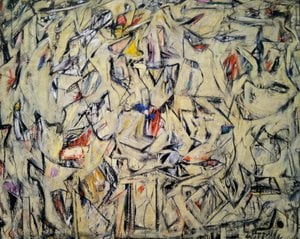
In the pantheon of Abstract Expressionism, few works capture the raw, kinetic energy of the mid-century New York art scene quite like Willem de Kooning’s Interchange. Completed in 1955, this monumental canvas serves as a profound testament to a pivotal moment in artistic evolution—a dramatic departure from de Kooning's earlier, more figurative depictions of the female form toward a bold, visceral exploration of urban landscapes. The painting is not merely a depiction of a city; it is an experience of one. Through a masterful command of expressive brushwork and a deliberate simplification of form, de Kooning invites the viewer into a world where the boundaries between structure and chaos dissolve into a vibrant, rhythmic dance of color and light.
The technical brilliance of Interchange lies in its palpable texture and the artist's heavy use of impasto. By applying paint in thick, deliberate layers with significant pressure, de Kooning created a surface defined by ridges and valleys that catch the light, lending the work a three-dimensional vitality. This technique was heavily influenced by the stark, gestural lines of Franz Kline, whose influence encouraged de Kooning to prioritize movement and emotional weight over meticulous representation. The composition is a deliberate study in asymmetry, utilizing fragmented geometric shapes—rectangles and trapezoids—that appear to collide and overlap amidst swirling, energetic strokes. This creates a sense of beautiful disorientation, mirroring the turbulent, fast-paced psychological landscape of the post-war era.
Beyond its technical prowess, Interchange carries a deep symbolic resonance that speaks to the human condition within the modern metropolis. The palette is dominated by a striking interplay of yellows and blacks, punctuated by sudden, unexpected flashes of blue and red. These colors do not merely sit upon the canvas; they interact with an intensity that suggests the flickering lights and shadowed alleys of a bustling city at dusk. The fragmented shapes can be seen as echoes of urban architecture—the skeletal remains of buildings or the fleeting silhouettes of street life—yet they remain abstract enough to represent the internal, emotional turbulence of the viewer. It is a painting that captures the very essence of "interchange"—the constant, restless movement of ideas, people, and energy that defines modern existence.
For the discerning collector or interior designer, an exquisite reproduction of this masterpiece offers more than just visual decoration; it provides a focal point of profound intellectual and emotional depth. The sheer scale and dynamism of de Kooning's vision make it an ideal centerpiece for spaces that demand character and sophistication. Whether placed in a contemporary gallery-style living room or a curated professional studio, the work brings with it the historical weight of the Abstract Expressionist movement. It serves as a window into a period of unparalleled creative freedom, offering a timeless sense of movement and a sophisticated dialogue between light and shadow that continues to inspire awe decades after its creation.
As recomendações de uso para "Untitled", de Willem de Kooning são (Accent) e o ambiente (Living Room).
Reproduções pintadas à mão de "Untitled", de Willem de Kooning podem ser adquiridas no este site: uma reprodução a óleo pintada à mão sobre tela de linho, através da sua página de encomendas Reprodução Pintada à Mão.
"Untitled", de Willem de Kooning está em ainda protegido por direitos autorais. O período de direitos autorais conta a partir do falecimento do artista, ocorrido em 1997.


1904 - 1997 , Países Baixos

Explore the profound emotional depth of Abstract Expressionism. From Pollock's dynamic drips to de Kooning's gestural mastery, our expert guide offers art collectors a sophisticated analysis of this transformative movement and its enduring legacy in modern fine art.
 Visualizar na parede
 Compartilhar
 Compartilhar
 Detalhes
 Guia
Guia

 Baixar imagem
 Semelhantes
 Raio X
 Ver diaporama
 Perguntas e Respostas
 Estatísticas

 Ler mais









 A opção de vidro está disponível apenas para tamanhos inferiores a 110 cm