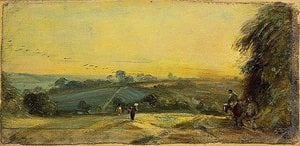
Willem Cornelis Rip: Echoes of the Dutch Polder
Born in Rotterdam in 1856, Willem Cornelis Rip emerged as a significant figure within the late 19th and early 20th-century Dutch art scene. His work, deeply rooted in the landscapes of his homeland – particularly the serene polders, canals, and skies of South Holland – transcends mere representation; it’s an exploration of mood, atmosphere, and the subtle poetry of everyday life. Rip wasn't a flamboyant innovator, but rather a meticulous observer who captured the essence of his subject matter with quiet confidence and remarkable technical skill.
Rip’s early artistic education was shaped by a somewhat unconventional path. Initially intended for lithography, he quickly gravitated towards painting, fueled by a desire to express himself through color and form. A royal allowance afforded him the opportunity to study in Munich under Karl Piloty, a historical painter whose influence is evident in Rip's early works – particularly his meticulous attention to detail and his preference for depicting scenes of rural life. However, it was Robert van Eijsden’s guidance back in Rotterdam that truly shaped Rip’s artistic vision. Van Eijsden, a prominent figure in the Hague School, encouraged Rip to immerse himself in nature, urging him to study directly from observation – a crucial step towards developing his distinctive style.
The Language of Light and Water
Rip's paintings are characterized by their atmospheric quality and masterful use of light. He rarely employed dramatic contrasts; instead, he favored subtle gradations of tone and color to evoke a sense of tranquility and introspection. His palette was predominantly muted – dominated by blues, greens, greys, and browns – reflecting the often overcast skies and subdued hues of the Dutch landscape. He excelled at capturing the fleeting effects of light on water, creating shimmering reflections that seemed to breathe with life. This fascination with water is a recurring motif in his work, representing not just a physical element but also a metaphor for reflection, memory, and the passage of time.
His technique was rooted in observation and careful planning. Rip often worked outdoors (plein air), meticulously sketching his subjects before committing them to canvas. He favored watercolor as his primary medium, appreciating its ability to capture delicate nuances of color and create a sense of immediacy. However, he also employed oil paints, particularly for larger works or when seeking greater depth and richness in his palette. The influence of the Hague School is clear in Rip’s approach – a focus on depicting familiar subjects with a heightened sensitivity to light and atmosphere, while maintaining a distinctly Dutch sensibility.
Travel Posters and International Recognition
Rip's career gained significant momentum through his work as a travel poster artist. His evocative depictions of the Vosges mountains in France (as seen in “Les Vosges”) and winter landscapes with skiing (“Samoëns-Sixt”) were particularly successful, capturing the spirit of adventure and the allure of distant destinations. These posters not only showcased his artistic talent but also helped to promote tourism to these regions. His work was exhibited extensively throughout Europe, including in prestigious venues such as the Paris World’s Fair in 1900 and Saint Louis in 1904, earning him recognition both domestically and internationally.
Notably, Rip's paintings found a receptive audience in America, where they were highly sought after by collectors. He even corresponded with Harry Wallis, a prominent London art dealer, discussing the sale of his works. This international success underscored the growing appreciation for Dutch landscape painting abroad and solidified Rip’s position as a respected artist within the European art world.
Legacy and Lasting Influence
Willem Cornelis Rip died in The Hague in 1922, leaving behind a substantial body of work that continues to resonate with viewers today. His paintings are characterized by their quiet beauty, atmospheric depth, and subtle symbolism – reflecting the enduring appeal of the Dutch landscape and the artist’s profound connection to his homeland. While he may not be as widely celebrated as some of his contemporaries within the Hague School, Rip's meticulous observation, masterful technique, and evocative imagery ensure that his work remains a valuable contribution to Dutch art history.
His legacy is preserved in museum collections across the Netherlands, including the Museum of Leeuwarden and the Middelburg Museum, testament to the enduring appreciation for his unique artistic vision. Rip’s paintings serve as a poignant reminder of the beauty and tranquility that can be found in the everyday landscapes of the Dutch polder.



 Visualizar na parede
 Alternar para Impressão
 Compartilhar
 Compartilhar
 Detalhes

 Baixar imagem
 Semelhantes
 Raio X
 Slideshow
 Estatísticas
 Ler mais