A Symphony in Squares: Exploring Victor Vasarely’s “Sreeh”
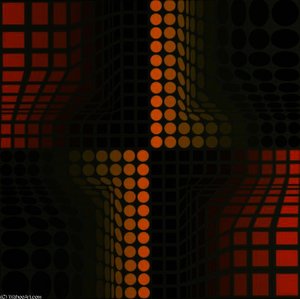
Victor Vasarely's "Sreeh" is more than just a painting; it’s an invitation into the heart of Op Art, a visual exploration of perception itself. This striking work, dominated by vibrant blues and yellows rendered through meticulously crafted geometric forms, embodies the artist’s pioneering role in creating dynamic illusions on canvas. The sheer density of squares, each subtly differentiated in hue and tone, immediately draws the eye, demanding attention and rewarding prolonged observation. It's a testament to Vasarely’s belief that art could actively engage with the viewer’s senses, challenging their assumptions about space and form.
The Genesis of Kinetic Art
Born Károly Vaszary in 1906 in Pécs, Croatia – then part of Austria-Hungary – Vasarely's artistic trajectory was remarkably unconventional. Initially drawn to medicine, he ultimately abandoned this path for the burgeoning world of painting in 1927, a decision profoundly shaped by his exposure to the Bauhaus movement and the influence of Sándor Bortnyik’s “Műhely” workshop. This environment fostered an intense interest in functional design and geometric abstraction – principles that would become the bedrock of his artistic practice. "Sreeh," therefore, represents a culmination of this early training, reflecting Vasarely's desire to translate scientific concepts about movement and visual perception into tangible artistic experiences. The painting’s creation aligns perfectly with the broader context of kinetic art emerging in the mid-20th century, where artists sought to capture the illusion of motion through static forms.
Technique and Illusion
Vasarely's technique is characterized by a remarkable precision and control. The painting’s impact isn’t simply due to its color palette; it’s fundamentally rooted in his mastery of optical illusions. Each square is meticulously rendered, creating subtle variations in size, shape, and shading that shift with the viewer’s perspective. This deliberate manipulation of visual cues generates a dynamic effect – an illusion of movement and depth that seems to vibrate before your eyes. The close-up composition further intensifies this effect, allowing for an intimate examination of the intricate details that contribute to the overall optical experience. The artist's use of layering and glazing techniques ensures that the colors retain their vibrancy and intensity, contributing significantly to the painting’s captivating visual impact.
Symbolism and Emotional Resonance
"Sreeh" transcends a mere geometric exercise; it speaks to fundamental human experiences – our perception of space, time, and movement. The repetition of squares, often associated with order and structure, is juxtaposed with the dynamic illusion created by Vasarely’s technique. This tension generates a sense of both stability and instability, inviting contemplation on the nature of reality itself. The bold use of blue and yellow – colors frequently linked to feelings of tranquility and energy respectively – adds another layer of emotional resonance to the work. Ultimately, “Sreeh” is an artwork that stimulates not just the eye but also the mind, prompting a deeper engagement with the complexities of visual perception.
Perguntas e Respostas
Qual artista e qual estilo estão por trás de "Sreeh"?
Por trás de "Sreeh" estão Victor Vasarely e o movimento Op Art.
A imagem de "Sreeh", de Victor Vasarely pode ser reproduzida livremente?
Informação de direitos autorais para "Sreeh", de Victor Vasarely: a obra está em ainda protegido por direitos autorais. Isso determina se reproduções da imagem podem ser feitas livremente.
Como posso visualizar uma reprodução de "Sreeh", de Victor Vasarely?
A página de Pré-visualização de "Sreeh" permite visualizar a obra de arte antes de fazer o pedido.



 Visualizar na parede
 Alternar para Impressão
 Compartilhar
 Compartilhar
 Detalhes
 Guia
Guia

 Baixar imagem
 Semelhantes
 Raio X
 Ver diaporama
 Q&A
Q&A Estatísticas

 Ler mais






































 A opção de vidro está disponível apenas para tamanhos inferiores a 110 cm