Sir-Ris: A Geometric Symphony of Perception
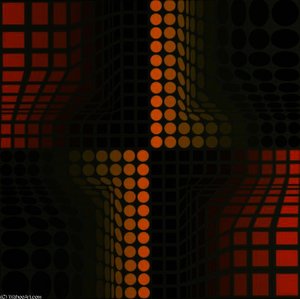
Victor Vasarely’s “SIR-RIS” is more than just a painting; it's an invitation into the mesmerizing realm of Op Art – Optical Art – a movement that fundamentally questioned how we perceive reality. Born Károly Vaszary in Pécs, Hungary (now Croatia), in 1906, Vasarely’s artistic journey began with medical studies but swiftly pivoted towards visual expression, fueled by an unwavering fascination with geometry and its ability to manipulate perception.
The artwork itself embodies the core tenets of Op Art. Executed in tempera on panel around 1959-1968, “SIR-RIS” presents a striking geometric pattern dominated by shades of blue interspersed with white accents. These aren’t merely decorative elements; they are meticulously crafted shapes—primarily spirals and concentric circles—that generate an illusion of movement when viewed from a certain angle. Vasarely's genius lay in harnessing mathematical principles to create visual vibrations that defy conventional representation.
Vasarely’s approach wasn’t driven by spontaneous creativity but by a rigorously defined system. He utilized grids and calculated proportions to generate patterns designed to stimulate the eye and induce sensations of depth—a deliberate departure from traditional painting techniques. Influenced by pioneers like Piet Mondrian and Kazimir Malevich, Vasarely sought to transcend static compositions, recognizing that art could actively engage the viewer’s senses.
The artwork's historical context is crucial to understanding its significance. Emerging in the mid-1960s, Op Art coincided with a broader cultural shift toward experimentation and questioning established norms. Artists like Vasarely challenged viewers to confront their assumptions about visual experience, prompting them to actively participate in constructing meaning.
“SIR-RIS”’s emotional impact is subtle yet profound. It doesn't evoke narrative emotion but rather invites contemplation—a quiet appreciation for the beauty of mathematical precision and its ability to generate captivating visual illusions. The artwork speaks to a desire for intellectual stimulation and aesthetic pleasure, reflecting Vasarely’s conviction that art could transcend mere decoration.
Fondation Vasarely continues to champion his legacy, showcasing his groundbreaking creations in Aix en Provence, France. Explore more about Victor Vasarely's life and work on Wikipedia.

Perguntas e Respostas
Sobre o que trata "SIR-RIS"?
Os temas de "SIR-RIS" são geometric patterns, optical illusion, color vibrations, spiral design, abstract art, dynamic composition, visual perception.
Qual é a cor predominante de "SIR-RIS" de Victor Vasarely?
Azul-aço (#50799e) é a cor predominante de "SIR-RIS" de Victor Vasarely.
Onde deve ser pendurada uma reprodução de "SIR-RIS" de Victor Vasarely?
O formato Formato quadrado de "SIR-RIS" de Victor Vasarely é recomendado para um(a) Sala de Estar. O formato e o espaço juntos orientam a disposição de uma reprodução.
Quão intensas são as cores em "SIR-RIS" de Victor Vasarely?
"SIR-RIS" de Victor Vasarely apresenta uma intensidade de cor Equilibrado.
As cores de "SIR-RIS" de Victor Vasarely são vibrantes ou suaves?
A cor de "SIR-RIS" possui Saturação suave e equilibrada de saturação e Equilibrado de intensidade.
Como posso visualizar uma reprodução de "SIR-RIS" de Victor Vasarely?
Uma prévia de "SIR-RIS" de Victor Vasarely está disponível na página de Visualização da obra.
"SIR-RIS" é típico do que Victor Vasarely costumava criar?
Os temas recorrentes de Victor Vasarely incluem geometric logic, visual vibration, dynamic form, systematic abstraction, artistic legacy; "SIR-RIS" foca em geometric patterns, optical illusion, color vibrations, spiral design, abstract art, dynamic composition, visual perception.
Qual técnica foi utilizada para "SIR-RIS" de Victor Vasarely?
Victor Vasarely utilizou a técnica de Acrílico sobre tela para "SIR-RIS". A técnica define a natureza material da obra original.



 Visualizar em escala
 Alternar para Impressão
 Enviar
 Compartilhar
 Ver detalhes
 Guia de Obras do Aluno

 Baixar imagem
 Semelhantes
 Raio X
 Apresentação de slides
 Estatísticas
 Ver mais






































 A opção de vidro está disponível apenas para tamanhos inferiores a 110 cm