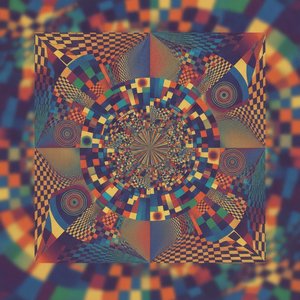
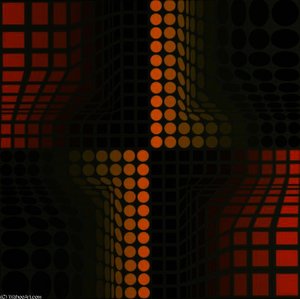
A Symphony of Geometric Precision: The Pulsating World of Sikra
To encounter Victor Vasarely’s “Sikra” is to step away from the stillness of traditional viewing and enter a realm where the canvas breathes, pulses, and vibrates with an engineered energy. This masterpiece stands as a cornerstone of the Op Art movement—a revolution in visual perception that challenged the mid-20th century to reconsider the very mechanics of sight. The painting is not merely a static arrangement of pigment; it is an intellectual exploration into how our eyes interpret color and form, reflecting Vasarely's profound fascination with the intersection of mathematics and artistic expression. As the viewer engages with the work, the surface seems to undergo a rhythmic dance, creating a kinetic experience that transforms a flat plane into a dynamic, living entity.
The visual language of “Sikra” is built upon a foundation of meticulous geometric precision. The composition is dominated by a mesmerizing interplay of vibrant hues—bold blues juxtaposed against fiery reds, and sunny yellows dancing alongside verdant greens. Within this chromatic landscape, Vasarely employs a complex framework of circles, squares, and triangles. These shapes are not merely decorative elements; they embody mathematical concepts such as tessellations and fractals, where repeating geometric patterns create an illusion of depth and movement without the need for overlapping layers. Through the careful manipulation of color gradients and spatial relationships, Vasarely achieves a sense of structural tension, making the eye wander through a labyrinth of light and perceived motion.
The Legacy of a Visionary: From Medicine to Motion
The genesis of such groundbreaking work lies in the unique life journey of the artist himself. Born Károly Vaszary in 1906 in Pécs, Vasarely’s path toward becoming the "grandfather" of Op Art was anything but linear. Originally pursuing medical studies at Eötvös Loránd University, his transition to the fine arts in 1927 marked a pivot from studying human anatomy to mastering a different kind of anatomy: the mechanics of perception. His formative years in Budapest, particularly his enrollment in Sándor Bortnyik’s Műhely workshop, deeply embedded him in the principles of the Bauhaus movement. This exposure to functional design and geometric abstraction became the DNA of his later works, instilling a lifelong dedication to the idea that art could be both mathematically rigorous and universally accessible.
For the modern collector or interior designer, “Sikra” offers more than just aesthetic beauty; it provides a focal point of profound intellectual depth. The painting’s ability to interact with its environment—changing its perceived character depending on light and angle—makes it an extraordinary choice for sophisticated spaces. Whether placed in a contemporary gallery setting or as a bold statement piece in a curated residential interior, the work invites conversation and contemplation. It serves as a reminder of a time when art broke free from the window-like perspective of the past to become a direct, visceral experience, offering a timeless sense of wonder that continues to captivate the human spirit.
Perguntas e Respostas
Como "Sikra", de Victor Vasarely pode ser utilizado na decoração de interiores?
As recomendações de uso para "Sikra", de Victor Vasarely são (Accent) e o ambiente (Living Room).
"Sikra" é uma das obras mais populares de Victor Vasarely?
"Sikra" é classificada como Iconic.
Que atmosfera uma reprodução de "Sikra", de Victor Vasarely traria para um ambiente?
Com sua atmosfera Elegant, "Sikra" é sugerida para um(a) Living Room.



 Visualizar na parede
 Comprar pintura feita à mão
 Compartilhar
 Compartilhar
 Detalhes
 Guia
Guia

 Baixar imagem
 Semelhantes
 Raio X
 Ver diaporama
 Estatísticas

 Ler mais






































 A opção de vidro está disponível apenas para tamanhos inferiores a 110 cm