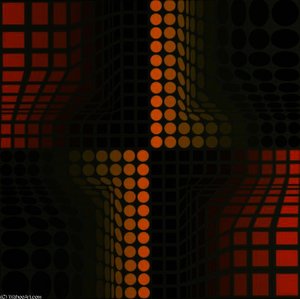
A Vortex of Color: Exploring Victor Vasarely’s “Pauk-Arny”
Victor Vasarely's "Pauk-Arny" is not merely a painting; it’s an invitation to experience the world through a radically altered lens. This vibrant composition, dominated by swirling reds, blues, and purples, embodies the core tenets of Op Art – Optical Art – a movement that emerged in the mid-20th century with the audacious goal of stimulating visual perception directly, bypassing conscious thought. Created by one of the pioneers of this groundbreaking style, Vasarely sought to translate mathematical principles and geometric abstraction into a captivating visual experience. The artwork’s dynamic spiral, constructed from meticulously arranged circles, immediately draws the eye inward, creating a sense of movement and depth that defies traditional representational art.
The Genesis of Op Art: Vasarely's Bauhaus Roots
Understanding “Pauk-Arny” requires acknowledging its historical context. Victor Vasarely’s artistic journey began with an unexpected detour – initially pursuing a medical degree before dedicating himself to painting in 1927. This shift was profoundly influenced by his enrollment at the Podolini-Volkmann Academy and, crucially, Sándor Bortnyik’s “Műhely” workshop, a school deeply rooted in the principles of the Bauhaus movement. The Bauhaus, with its emphasis on functional design, geometric abstraction, and the exploration of industrial materials, provided Vasarely with the theoretical framework for his artistic explorations. He wasn't simply creating pretty pictures; he was investigating how our eyes perceive space, motion, and color – a fascination that would define his entire career.
Decoding the Spiral: Geometry and Perception
The spiral itself is central to “Pauk-Arny’s” impact. Vasarely meticulously employed geometric shapes—circles—to construct this dynamic form. This technique, characteristic of Op Art, exploits optical illusions. The overlapping circles create a sense of movement and depth, mimicking the visual effects of kinetic art – art that creates the illusion of motion without actual physical movement. The viewer’s eye is constantly drawn across the surface, creating a stimulating and almost hypnotic effect. It's a testament to Vasarely's belief that art could directly engage our senses and challenge our conventional understanding of reality.
Symbolism and Emotional Resonance
"Pauk-Arny" transcends mere optical stimulation; it evokes a profound sense of dynamism and energy. The swirling colors, reminiscent of nebulae or the patterns found in nature, suggest an infinite expanse – a visual representation of boundless possibility. While Vasarely intentionally avoided explicit symbolism, the artwork’s inherent qualities—its movement, its complexity, and its vibrant color palette—invite contemplation on themes of order and chaos, control and freedom. The piece's impact is undeniably emotional, prompting feelings of excitement, wonder, and a heightened awareness of visual perception.



 Visualizar em escala
 Alternar para Impressão
 Enviar
 Compartilhar
 Ver detalhes

 Baixar imagem
 Semelhantes
 Raio X
 Apresentação de slides
 Estatísticas

 Ver mais






































 A opção de vidro está disponível apenas para tamanhos inferiores a 110 cm