A Symphony in Geometric Abstraction: Exploring Victor Vasarely’s “Maamor va”
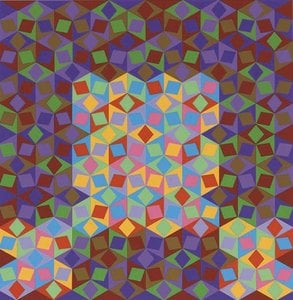
Victor Vasarely's "Maamor va" is more than just a painting; it’s an invitation to deconstruct reality, a visual meditation on perception itself. This captivating work, dominated by a vibrant interplay of blue and yellow geometric forms, embodies the core tenets of Op Art – Optical Art – a movement that emerged in the mid-20th century and profoundly impacted the course of modern art. The piece’s immediate impact lies in its dynamic surface; a mesmerizing mosaic of squares and triangles seemingly floating within a carefully orchestrated space. It's a testament to Vasarely’s meticulous approach, born from his early studies in medicine – an unexpected foundation for a revolutionary artist who sought to manipulate the viewer’s visual experience.
- Subject Matter: The subject matter is deliberately abstract. Vasarely wasn't interested in depicting recognizable objects or scenes; instead, he focused on exploring the fundamental properties of light and color, and how they interact with our perception of space.
- Style & Technique: “Maamor va” exemplifies Vasarely’s signature style – a precise application of geometric abstraction. He employed a technique known as ‘static illusion,’ meticulously layering colored squares and triangles to create the impression of movement and depth, despite the inherent stillness of the composition. The use of flat planes and hard-edged forms is characteristic of his approach, rejecting traditional notions of perspective and representation.
The Genesis of Op Art: Vasarely’s Bauhaus Roots
Vasarely's artistic journey began with a formal education in medicine, a path he ultimately abandoned to pursue his passion for visual expression. This pivotal shift occurred during his time at the Podolini-Volkmann Academy and, crucially, within Sándor Bortnyik’s “Műhely” workshop – a space deeply influenced by the Bauhaus movement. The Bauhaus, with its emphasis on functional design, geometric abstraction, and the exploration of industrial materials, provided Vasarely with the theoretical framework for his groundbreaking work. He absorbed the principles of reducing form to its essential elements – lines, planes, and colors – believing that these could be used to create optical illusions and manipulate perception in a controlled manner. This influence is clearly visible in “Maamor va,” where the precise arrangement of shapes generates a dynamic visual effect.
Decoding the Visual Illusion
The beauty of "Maamor va" lies not just in its aesthetic appeal but also in its technical sophistication. Vasarely was fascinated by the way our eyes and brains interpret visual information, particularly how they perceive movement and depth. The seemingly random arrangement of squares and triangles is, in fact, a carefully calculated system designed to trick the eye. By manipulating color, size, and spacing, he created an optical illusion that generates a sense of dynamism and movement – a key characteristic of Op Art. The subtle variations in hue and tone within each shape contribute to this effect, further enhancing the painting’s visual complexity.
Symbolism & Emotional Impact
While abstract in its execution, “Maamor va” resonates with deeper symbolic meanings. The geometric forms can be interpreted as representing fundamental building blocks of reality – the elements that constitute our perception of the world. The vibrant colors evoke a sense of energy and excitement, reflecting Vasarely’s belief in the power of art to transform our experience of space and time. Ultimately, this artwork invites contemplation on the nature of visual perception and the relationship between the artist's intention and the viewer's interpretation. It is a powerful reminder that reality itself can be a construct, shaped by our own sensory experiences.
Perguntas e Respostas
Quais temas aparecem em "Maamor va", de Victor Vasarely?
Os temas de "Maamor va" são geometric abstraction, optical illusions, color field painting, modern design art, abstract patterning, visual harmony, vibrant composition.
Para que uso é sugerida a reprodução de "Maamor va", de Victor Vasarely?
O uso sugerido para "Maamor va", de Victor Vasarely é Accent, podendo também ser utilizado para outros fins.
"Maamor va", de Victor Vasarely está entre as obras de Op Art mais procuradas?
Dentro do movimento Op Art, "Maamor va" possui um nível de popularidade Iconic.



 Visualizar na parede
 Comprar pintura feita à mão
 Compartilhar
 Compartilhar
 Detalhes
 Guia
Guia

 Baixar imagem
 Semelhantes
 Raio X
 Ver diaporama
 Estatísticas

 Ler mais






































 A opção de vidro está disponível apenas para tamanhos inferiores a 110 cm