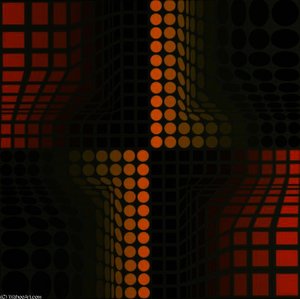
The Pulse of Perception: Unveiling Vasarely’s Kezdi-Ga
To encounter Victor Vasarely’s Kezdi-Ga is to step away from the stillness of traditional viewing and enter a realm where the canvas breathes, pulses, and vibrates with an engineered energy. Created in 1967, this masterpiece stands as a cornerstone of the Op Art movement, a visual phenomenon that redefined the relationship between the viewer and the artwork. Unlike the emotive, sweeping gestures of Abstract Expressionism, Kezdi-Ga does not seek to tell a story or convey a specific sentiment; instead, it seeks to stimulate the very mechanics of human sight. It is a scientific investigation disguised as art, a rhythmic dance between mathematics and magic that invites the eye to wander through a labyrinth of light, shape, and perceived motion.
The composition is a symphony of geometric precision, dominated by a central, luminous sphere that appears to float precariously above the surface. This central orb is composed of a meticulous arrangement of smaller spheres in alternating shades of deep blue and brilliant white, creating a profound three-dimensional effect. Surrounding this core, an array of diamond shapes radiates outward like a cosmic vortex, their colors transitioning through various gradients of blue to suggest a receding tunnel or a swirling whirlpool. This use of concentric patterns and contrasting tones creates a hypnotic depth, pulling the observer into a rhythmic, kaleidoscopic experience that challenges our fundamental assumptions about stability and space.
A Legacy of Geometry and Illusion
The roots of this optical brilliance can be traced back to Vasarely’s formative years and his encounter with the principles of the Bauhaus movement. Influenced by the functionalist energy of Sándor Bortnyik’s workshop, Vasarely abandoned a promising path in medical studies to master a different kind of anatomy: the anatomy of vision itself. His work is characterized by this rigorous, disciplined approach to form, where every circle and square is placed with mathematical intent to trigger a sensory response. In Kezdi-Ga, we see the culmination of this lifelong pursuit—the ability to use precise geometric abstraction to create an unsettling yet captivating sensation of movement.
For the modern collector or interior designer, a high-quality reproduction of Kezdi-Ga offers more than mere decoration; it provides a focal point of intellectual and visual intrigue. The painting’s ability to interact with light and the viewer's perspective makes it a dynamic addition to any sophisticated space, capable of transforming a static room into an immersive environment. It serves as a conversation piece that bridges the gap between mid-century modernism and contemporary aesthetic sensibilities, offering a timeless window into the fascinating mechanics of how we perceive reality.



 Visualizar em escala
 Encomendar reprodução pintada à mão
 Enviar
 Compartilhar
 Ver detalhes

 Baixar imagem
 Semelhantes
 Raio X
 Apresentação de slides
 Estatísticas

 Ver mais






































 A opção de vidro está disponível apenas para tamanhos inferiores a 110 cm