A obra de arte exibida nesta página é protegida por leis de direitos autorais, o que significa que não podemos criar ou vender legalmente uma reprodução idêntica. Esta proteção é aplicada por meio de acordos internacionais, tais como a Convenção de Berna e pelas leis nacionais, incluindo as estabelecidas por Lei de Direitos Autorais dos EUA - Título 17.
Este método cumpre plenamente as regulamentações de direitos autorais, pois não envolve a cópia ou duplicação da obra protegida. Em vez disso, trata-se de uma reinterpretação criativa — uma nova pintura que é influenciada pela original, mas não idêntica a ela.
Impressão giclée ou em tela de qualidade de museu, com produção rápida e opções flexíveis de acabamento. ( Comprar pintura feita à mão Alternar para Imagem Digital)





























Escolha entre os nossos tamanhos pré-definidos que respeitam as proporções originais da obra de arte.

Insira a largura e a altura desejadas para se ajustarem à sua moldura ou parede. Uma impressão pode ser apenas cortada, nunca ampliada além da imagem original; portanto, um tamanho com proporções diferentes resultará na perda de parte da imagem. Enviamos uma maquete digital para sua aprovação antes de realizarmos a impressão. A imagem exibida nesta página não mostra o corte real — apenas a maquete o faz.
Entrega mundial () em 2 semanas, em vez das 4/5 semanas padrão. (8 Novembro)
Hetta
Tamanho da Reprodução
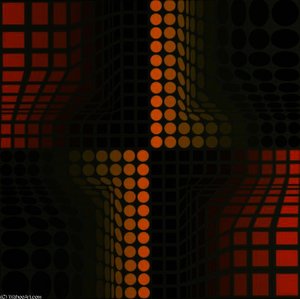
Victor Vasarely's "Hetta," a deceptively simple composition of four vibrant circles – red, orange, green, and blue – is far more than just an abstract arrangement. It’s a meticulously crafted exploration of perception, movement, and the very nature of visual experience, firmly rooted in the groundbreaking principles of Op Art and reflecting the artist's deep engagement with geometric abstraction. Born Károly Vaszary in 1906 in Pécs, Croatia, Vasarely’s artistic trajectory began unexpectedly, initially driven by a medical education before he was captivated by the expressive potential of painting. This shift, catalyzed by his studies at the Podolini-Volkmann Academy and crucially, Sándor Bortnyik's “Műhely” workshop – a breeding ground for Bauhaus ideals – established him as a key figure in challenging traditional artistic conventions. "Hetta" embodies this legacy, showcasing Vasarely’s mastery of creating illusions through precise geometric forms, anticipating the viewer’s eye and manipulating their perception with remarkable skill.
“Hetta” is a quintessential example of Op Art, a movement that emerged in the 1960s – though Vasarely's explorations began decades earlier – to deliberately stimulate visual responses through optical illusions. The painting’s seemingly static arrangement generates a dynamic sense of movement and vibration within the viewer’s eye. This effect is achieved through carefully calibrated patterns and contrasting colors, creating areas of light and dark that shift with the slightest change in viewing angle. Vasarely wasn't simply depicting circles; he was manipulating the way the brain processes visual information, demonstrating a profound understanding of how our perception is constructed.
Vasarely’s artistic vocabulary is profoundly shaped by his immersion in geometric abstraction and the principles championed by the Bauhaus movement. The precise, interlocking circles within “Hetta” reflect the Bauhaus emphasis on functional design and the reduction of form to its essential elements – line, shape, and color. This approach sought to create art that was both aesthetically pleasing and intellectually stimulating, rejecting representational imagery in favor of exploring the underlying structure of visual reality. The square arrangement of the circles further reinforces this geometric rigor, echoing the Bauhaus’s commitment to order and clarity.
While ostensibly abstract, “Hetta” possesses a subtle symbolic resonance. The four colors – red, orange, green, and blue – are often associated with fundamental human emotions: passion (red), enthusiasm (orange), growth (green), and tranquility (blue). Their arrangement within the circles suggests a harmonious balance or perhaps a dynamic interplay between these forces. More than just an aesthetic object, “Hetta” invites contemplation on perception itself, prompting viewers to question their own assumptions about reality and the nature of visual experience. The painting’s impact is one of controlled excitement – a quiet dynamism that draws the eye in and holds it captive.
O guia para "Hetta" é a página de Ficha informativa da obra — uma ficha informativa imprimível que apresenta a obra com sua legenda, autoria e tabela de identificação (artista, datas, técnica, tamanho original, coleção).
"Hetta", de Victor Vasarely retrata: circles, geometry, op art, abstraction, color field, vasarely, visual perception.
Em "Hetta", cores de Dark acompanham um sentimento Reflective.

1906 - 1997 , Croácia

Explore the mesmerizing world of Victor Vasarely. Discover how his Bauhaus-inspired Op Art masters the science of perception through geometric abstraction and vibrant color. A sophisticated guide for discerning art collectors seeking to understand the legacy of optical illusion.

Explore the profound spiritual depth of geometric abstraction. From Malevich's Suprematism to modern masters, our expert guide reveals how pure form and color command presence in fine art collections.
 Visualizar na parede
 Compartilhar
 Compartilhar
 Detalhes
 Guia
Guia

 Baixar imagem
 Semelhantes
 Raio X
 Ver diaporama
 Perguntas e Respostas
 Estatísticas

 Ler mais









 A opção de vidro está disponível apenas para tamanhos inferiores a 110 cm