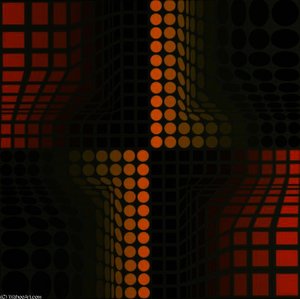
Victor Vasarely’s “GESTALT 1”: A Geometric Revelation
“GESTALT 1,” a striking depiction of a vibrant red and blue cube punctuated by a central hole, is a quintessential example of Victor Vasarely's groundbreaking contribution to Op Art and kinetic art. Executed with meticulous attention to detail, this artwork transcends mere representation, offering instead an exploration of perception itself – a core tenet of Vasarely’s artistic philosophy. The painting’s immediate impact stems from the bold juxtaposition of color; the intense red and blue create a dynamic tension that draws the viewer's eye across the surface, while the checkered pattern adds another layer of visual complexity, further stimulating the brain’s processing capabilities.
The Birth of Op Art and Geometric Abstraction
- Historical Context: Created by Victor Vasarely during a period of intense artistic experimentation in the mid-20th century, “GESTALT 1” reflects the broader movement towards abstraction that emerged after World War II. The rise of Op Art, pioneered by artists like Bridget Riley and Richard Hamilton, sought to evoke optical illusions through carefully controlled patterns and color relationships.
- Vasarely’s Influence: Vasarely was a key figure in this movement, developing his own unique style rooted in geometric abstraction and influenced heavily by the Bauhaus principles of functional design. His work wasn't simply about creating beautiful images; it was about manipulating visual perception.
- Kinetic Art Connection: Vasarely’s exploration extended beyond static paintings, anticipating the concepts of kinetic art – works designed to create an illusion of movement through optical effects.
Decoding the Symbolism of Form and Space
The seemingly simple image of a cube is laden with symbolic meaning within Vasarely’s oeuvre. The cube, a fundamental geometric shape, represents stability, order, and structure – concepts that were deliberately disrupted by the checkerboard pattern and the void at its center. This deliberate disruption challenges our innate desire for visual coherence, forcing us to actively engage in the process of interpretation. The hole itself can be interpreted as an absence, a negative space that amplifies the impact of the surrounding forms, or perhaps as a portal – inviting the viewer into the artwork’s perceptual realm.
Technique and Materiality: A Precision Execution
While the exact materials used in the original painting are unknown, this hand-painted reproduction faithfully captures Vasarely's meticulous technique. The sharp lines, precise color blending, and careful application of paint demonstrate a dedication to technical mastery – a hallmark of Vasarely’s work. The use of vibrant pigments ensures that the artwork retains its intensity and visual impact, creating a piece that is both intellectually stimulating and aesthetically pleasing. The reproduction utilizes archival-quality materials to guarantee longevity and preserve the original artwork's brilliance for generations to come.
Emotional Impact and Artistic Legacy
"GESTALT 1" isn’t merely an eye-catching visual; it’s a profound meditation on perception, order, and chaos. It evokes a sense of wonder and invites the viewer to question their own assumptions about reality. Vasarely's work continues to resonate with contemporary audiences, demonstrating the enduring power of geometric abstraction to challenge and inspire. This reproduction offers an opportunity to experience firsthand the brilliance of one of 20th-century art’s most innovative minds.
Perguntas e Respostas
"GESTALT 1" está livre de direitos autorais?
Quanto aos direitos autorais, "GESTALT 1" está em ainda protegido por direitos autorais.
Existe uma apresentação de slides para "GESTALT 1" de Victor Vasarely?
O diaporama de "GESTALT 1" pode ser visualizado na página Apresentação de slides da obra.
Que emoção transmite "GESTALT 1" de Victor Vasarely?
O tom emocional registrado para "GESTALT 1" de Victor Vasarely é Reflective. Ele resume o sentimento que a obra expressa.



 Visualizar em escala
 Encomendar reprodução pintada à mão
 Enviar
 Compartilhar
 Ver detalhes
 Guia de Obras do Aluno

 Baixar imagem
 Semelhantes
 Raio X
 Apresentação de slides
 Estatísticas

 Ver mais






































 A opção de vidro está disponível apenas para tamanhos inferiores a 110 cm