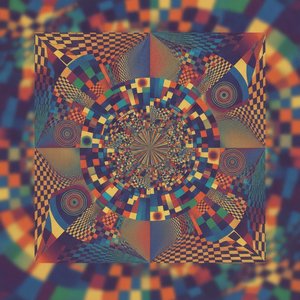
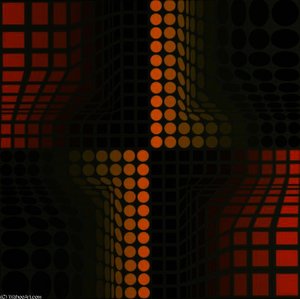
A Kaleidoscope of Perception: Exploring Victor Vasarely’s “Enigmes”
Victor Vasarely's "Enigmes" is not merely a painting; it’s an invitation into the very mechanics of visual perception. Completed in a period brimming with artistic experimentation, this vibrant geometric composition embodies the core tenets of Op Art – Optical Art – a movement that sought to challenge our understanding of how we see and interpret the world. Born in 1906 in Pécs, Croatia (then part of Austria-Hungary), Vasarely’s journey began unexpectedly, initially with medical studies before he was drawn to the expressive potential of color and form. His formative years within the Bauhaus-influenced Műhely workshop instilled a rigorous approach to geometric abstraction, a foundation upon which he built his revolutionary style.
- Subject Matter: The artwork presents a dazzling array of shapes – circles, squares, triangles, and diamonds – arranged in an intricate, almost hypnotic pattern. It’s a deliberate deconstruction of visual reality, stripping away representational imagery to focus solely on the properties of shape and color.
- Style & Technique: Vasarely's technique is characterized by precise, meticulously executed geometric forms. He employed a method he termed “static movement,” creating an illusion of motion through carefully calibrated variations in size, color, and spatial arrangement. The painting’s surface appears to shimmer and shift with the viewer’s perspective, a testament to his mastery of optical illusions.
The Rise of Op Art and Kinetic Vision
"Enigmes" emerged from a pivotal moment in 20th-century art – the rise of Op Art. Following World War I, artists sought new ways to engage with viewers, moving beyond traditional representational painting. Op Art, spearheaded by figures like Vasarely and Bridget Riley, utilized optical illusions to create dynamic effects on a flat surface. This was fueled by advancements in color theory and a growing fascination with the science of perception. Vasarely’s work anticipated developments in kinetic art, exploring how visual stimuli could evoke a sense of movement and energy within the observer.
The influence of movements like Constructivism and De Stijl is also evident, reflecting a broader European artistic dialogue concerned with abstraction, order, and the exploration of fundamental geometric principles. Vasarely’s work wasn't simply about creating pretty patterns; it was a serious investigation into the nature of visual experience.
Decoding the Symbolism: Order from Chaos
While seemingly abstract, "Enigmes" subtly evokes a sense of order within apparent chaos. The precise arrangement of shapes – circles, squares, triangles, and diamonds – suggests a mathematical harmony, reflecting Vasarely’s belief that art could reveal underlying structures of the universe. The repetition and variation in size create a visual rhythm, drawing the eye across the canvas and generating a sense of dynamic equilibrium. The use of vibrant colors further amplifies this effect, contributing to the painting's captivating intensity.
Emotional Impact & Collecting
"Enigmes" possesses a powerful emotional impact, inviting viewers to lose themselves in its mesmerizing patterns. It’s a piece that stimulates the mind and awakens the senses, prompting contemplation on the nature of perception itself. As a significant work by one of the pioneers of Op Art, this painting represents a valuable addition to any collection of modern or contemporary art. WahooArt offers meticulously crafted hand-painted reproductions of "Enigmes," ensuring that you can experience the full impact of Vasarely’s vision in stunning detail and vibrant color – a timeless masterpiece for your home or office.
Perguntas e Respostas
Qual é a cor predominante em "Enigmes"?
A tonalidade dominante de "Enigmes", de Victor Vasarely é Green to Violet Spectrum. A tonalidade é o tom subjacente da paleta.
As cores de "Enigmes" são vibrantes ou suaves?
"Enigmes", de Victor Vasarely apresenta uma saturação Balanced Soft e uma intensidade Balanced.
Qual é a atmosfera de "Enigmes"?
A atmosfera geral de "Enigmes", de Victor Vasarely é Modern. O clima descreve a sensação predominante da obra.



 Visualizar na parede
 Comprar pintura feita à mão
 Compartilhar
 Compartilhar
 Detalhes
 Guia
Guia

 Baixar imagem
 Semelhantes
 Raio X
 Ver diaporama
 Estatísticas

 Ler mais






































 A opção de vidro está disponível apenas para tamanhos inferiores a 110 cm