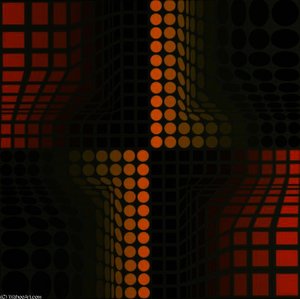
Victor Vasarely’s “Abstract Composition 17”: A Dance of Perception
Victor Vasarely's "Abstract Composition 17" is more than just an image; it’s an invitation to experience the world anew. Born in 1906 in Pécs, Croatia – then part of Austria-Hungary – Vasarely’s life was a deliberate pursuit of visual harmony, beginning with a surprising detour from medical studies into the realm of art. His early training at the Podolini-Volkmann Academy and, crucially, Sándor Bortnyik's “Műhely” workshop, profoundly shaped his approach, immersing him in the principles of functional design and geometric abstraction championed by the Bauhaus movement. This confluence of influences ultimately led to his groundbreaking contribution to Op Art – Optical Art – a style dedicated to manipulating perception through carefully constructed visual illusions.
The Geometry of Movement
This striking black-and-white composition exemplifies Vasarely’s mastery of Op Art. The artwork is dominated by an intricate network of interlocking lines, squares, and rectangles, meticulously arranged to create a dynamic sense of movement and depth. It's a deliberate rejection of traditional representational art; the focus isn't on depicting a recognizable scene but rather on exploring the very nature of visual perception. Vasarely’s technique involved precise execution – oil paint applied with exacting control onto canvas – to achieve this remarkable effect. The high contrast between black and white amplifies these optical effects, drawing the viewer into a captivating dance of shifting forms.
A Historical Context: Op Art and the Pursuit of Illusion
Emerging in the 1960s, Op Art represented a significant shift in artistic thinking. Artists like Vasarely sought to harness scientific principles – particularly those related to optics and visual perception – to create artwork that actively engaged the viewer’s eye. This wasn't simply about creating pretty patterns; it was an intellectual exploration of how our brains interpret visual information. The movement coincided with a broader cultural fascination with technology and its impact on human experience, reflecting a desire to understand and manipulate the world around us through new artistic means.
Symbolism and Emotional Impact
"Abstract Composition 17" possesses a profound symbolic resonance despite its lack of overt subject matter. The geometric forms – squares, rectangles, lines – can be interpreted as representing fundamental building blocks of reality, suggesting an underlying order within apparent chaos. The artwork’s ability to generate movement and vibration taps into primal human responses, evoking feelings of excitement, dynamism, and even a subtle sense of unease. It's a piece that demands attention, prompting the viewer to actively participate in its creation – to become part of the illusion itself.
Perguntas e Respostas
A qual artista "Abstract Composition 17" é atribuída?
"Abstract Composition 17" é atribuída a Victor Vasarely.
Onde "Abstract Composition 17" se posiciona dentro da obra de Victor Vasarely?
"Abstract Composition 17" pertence à obra Op-Art de Victor Vasarely, cujos temas recorrentes incluem bauhaus, geometric abstraction, kinetic art exploration, visual perception studies, op-art pioneer work, signature style development.
De qual país é a obra do Op-Art "Abstract Composition 17"?
"Abstract Composition 17" conecta o movimento Op-Art com Croácia por meio do local de nascimento de seu criador.
Existe um guia para "Abstract Composition 17" de Victor Vasarely?
Uma página de Guia está disponível para "Abstract Composition 17" de Victor Vasarely: uma ficha informativa imprimível sobre a obra, projetada para estudantes e uso em sala de aula.
Quem vende cópias pintadas à mão de "Abstract Composition 17" de Victor Vasarely?
Você pode encomendar uma reprodução pintada à mão de "Abstract Composition 17" de Victor Vasarely diretamente em esta página: uma reprodução a óleo pintada à mão sobre tela de linho, feita sob encomenda.
Como posso adquirir uma impressão de "Abstract Composition 17" de Victor Vasarely?
Uma impressão de "Abstract Composition 17" de Victor Vasarely pode ser encomendada diretamente em esta página: uma impressão fine art em tela de algodão ou papel canvas de arquivo.
Como posso obter um arquivo digital de "Abstract Composition 17" de Victor Vasarely?
Para obter um arquivo digital de "Abstract Composition 17" de Victor Vasarely, peça download de imagem digital em alta resolução em esta página.



 Visualizar em escala
 Encomendar reprodução pintada à mão
 Enviar
 Compartilhar
 Ver detalhes
 Guia de Obras do Aluno

 Baixar imagem
 Semelhantes
 Raio X
 Apresentação de slides
 Estatísticas

 Ver mais






































 A opção de vidro está disponível apenas para tamanhos inferiores a 110 cm