Obtenha um arquivo pronto para impressão que vai muito além da visualização na web. Cada imagem digital que vendemos provém de um arquivo mestre de alta resolução em nosso banco de dados — geralmente entre 5.000 e 15.000 pixels de largura — para que você possa imprimir em grandes formatos, realizar cortes precisos ou reproduzir detalhes minuciosos com total confiança.
Nenhum arquivo sai do nosso estúdio sem passar por um cuidadoso processo de revisão. Um especialista digital verifica as cores em relação à pintura original e as corrige se necessário, aumentando então a clareza e o detalhe com ferramentas profissionais de retoque — sempre mantendo a fidelidade às pinceladas e ao estilo do artista. O resultado é uma imagem que se assemelha à pintura, e não a um scan com filtros.
Aprovação antes da finalização: nosso especialista enviará a imagem por e-mail em até 72 horas para sua revisão. Não ficou satisfeito? Solicite melhorias ou correções, ou peça o reembolso caso a qualidade não atenda às suas expectativas.
Esta é a qualidade em que confiam editoras, estúdios de design, galerias e gráficas.
Baixe um arquivo de alta resolução para exibição pessoal, impressão e projetos criativos. ( Alternar para Impressão Comprar pintura feita à mão)
Ao escolher o WahooArt.com, você não está apenas adquirindo uma imagem — você está recebendo uma obra de arte digital profissionalmente aprimorada, elaborada com precisão e com garantia de satisfação. Aqui está tudo o que acompanha seu pedido, automaticamente:
O seu arquivo de imagem digital em alta resolução será enviado por e-mail em até 72 horas após o pedido — pronto para uso imediato.
Sua obra de arte é otimizada profissionalmente por meio de ferramentas avançadas de IA e edição manual, garantindo o máximo de detalhes, clareza e precisão de cores.
Apagou ou perdeu o seu ficheiro acidentalmente? Não se preocupe – nós reenviamos para si a qualquer momento, gratuitamente.
Desfrute da sua obra de arte instantaneamente, sem taxas alfandegárias, impostos ou custos de entrega — downloads digitais são sempre isentos de taxas.
Garantimos que sua imagem digital reflita as cores originais com a maior fidelidade possível, utilizando ferramentas profissionais e gerenciamento de cores.
Se não estiver satisfeito com a sua imagem digital, nós a revisaremos ou reembolsaremos 100% dentro de 100 dias — sem perguntas.
Não está satisfeito? Receba o reembolso total em até 100 dias após o recebimento do seu arquivo digital — sem perguntas.
Compre 3 imagens, economize 10% - Compre 5, economize 15% - Compre 10+, economize 20%. Ideal para projetos criativos, galerias e agências.
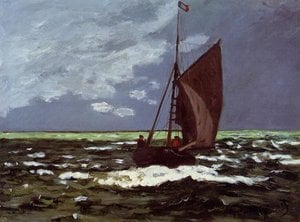
A heavy, dark indigo water rises in diagonal lines across the canvas. Large, cresting waves move with a raw, turbulent energy, pushing toward the viewer from a low vantage point within the sea itself. Deep charcoal grays and blacks dominate the depths of the ocean, while muted whites mark the churning foam at the peaks. The ships appear as dark silhouettes, their sharp, angular masts providing a structural contrast to the organic, undulating shapes of the waves. Light breaks through thick, overcast clouds in a chiaroscuro effect, catching only the highest points of the spray and the edges of the vessels.
The year 1627 marks this moment of maritime peril. The painting utilizes oil on canvas to achieve atmospheric depth and realistic light effects characteristic of Baroque maritime painting. Through delicate brushwork, a sense of mist and salt spray settles over the scene. The composition captures multiple sailing vessels struggling against massive swells, creating a feeling of isolation and the immense power of nature. A pale ochre tint touches the heavy clouds above the dark water.
The sea remains restless.
"Seascape", de Claes Claesz. Wou retrata: waves, ships, sea, clouds, dark blue, white foam, ocean.
Quanto aos direitos autorais, "Seascape" está em em domínio público — seus direitos autorais expiraram.
"Seascape" pode ser examinado camada por camada na página Raio X da obra, um visualizador inspirado em uma mesa de luz de conservação com onze leituras ópticas da imagem.

In the narrow streets of Amsterdam, where the water meets the stone, Claes Claesz. Wou lived a life tied to the movement of the tides. Born in 1592, he was a man of the city, moving from the quiet outskirts of Buitenveldert to the bustling Prinsengracht near the Laurierstraat. He was more than a painter; he held the position of a waard in 't Groene Woudt, a role that suggests a life deeply embedded in the local community. There was a certain social weight to his presence, though perhaps not a financial one. At the time of his death in 1665, he left behind many debts owed by his fellow artists, a detail that hints at a man who lived closely among his peers, perhaps spending as much time in their company as he did at his easel.
His hands were accustomed to the brush, but his eyes were fixed on the horizon. He did not seek the bright, clear skies of the Mediterranean. Instead, he found his subject in the heavy, churning waters of the North Sea. His work focused on the struggle of ships against the elements, capturing the weight of a storm and the spray of salt against wood.
Wou’s technique was one of restraint and atmosphere. He did not rely on a wide palette to tell his story. Instead, he worked within a restricted range, often using a monochrome grey to build the depth of a storm. He understood how light breaks through a heavy sky to hit the crest of a wave. His compositions were defined by a low horizon, a choice that forces the viewer to look up at the vastness of the sky and the chaos of the water, making the ships appear small and vulnerable against the immense scale of the ocean.
His approach to the sea was shaped by specific technical choices:
The influence of Wou can be seen in the way he translated the movement of water onto a flat surface. He was not a solitary figure in the art world, but one who sat at the center of a circle of makers. It is believed that he may have been the teacher of Jan Abrahamsz. van Beerstraten, another painter who dedicated his life to the same maritime subjects. This connection suggests a continuity of style and a passing down of the specific way to capture a storm. He remained active in his craft from 1612 until his death in 1665, a long life spent observing the way the light changes over the water.

1592 - 1665 , Netherlands
 Visualizar na parede
 Compartilhar
 Compartilhar
 Detalhes
 Guia
Guia

 Baixar imagem
 Semelhantes
 Raio X
 Ver diaporama
 Perguntas e Respostas
 Estatísticas

 Ler mais