Impressão giclée ou em tela de qualidade de museu, com produção rápida e opções flexíveis de acabamento. ( Comprar pintura feita à mão Comprar imagem)





























Escolha entre os nossos tamanhos pré-definidos que respeitam as proporções originais da obra de arte.

Você pode inserir suas próprias dimensões para se ajustar a uma moldura ou espaço específico. Se o tamanho selecionado não corresponder às proporções da imagem original, iremos recortar a obra de arte ou estender a imagem com uma borda espelhada ou preenchimento sólido. Um mockup digital será enviado para sua aprovação antes do início da produção.
Por favor, observe que a visualização na tela não reflete o recorte ou a extensão real. Apenas o mockup mostrará com precisão a composição final.
Embora tamanhos personalizados estejam disponíveis, recomendamos selecionar uma dimensão da lista predefinida para preservar as proporções originais.
Entrega mundial () em 2 semanas, em vez das 4/5 semanas padrão. (7 Setembro)


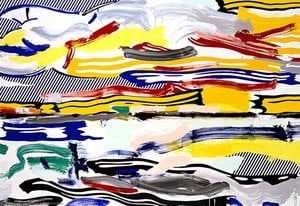
Untitled (1960)
Tamanho da Reprodução
Before the world came to know Roy Lichtenstein as the master of the Ben-Day dot and the architect of comic-strip chic, there existed a different, more visceral version of his creative soul. His 1960 work, Untitled, serves as a breathtaking window into a pivotal moment of transition, capturing an artist caught in the throes of Abstract Expressionism. In this piece, we encounter a creator unburdened by the irony and mechanical precision that would later define his career. Instead, we find a painter deeply engaged with the spontaneous, the tactile, and the profoundly emotional. It is a rare, intimate glimpse into the laboratory of a genius, where the heavy weight of post-war tension meets the liberating movement of the brush.
The canvas acts as a battlefield of color and motion, eschewing any recognizable subject in favor of pure, unadulterated feeling. There are no characters here, no narratives to decode—only the rhythmic dance of blues, reds, yellows, greens, and browns set against a muted, pale grey expanse. The composition lacks a traditional focal point, inviting the viewer’s eye to wander through a chaotic yet strangely harmonious arrangement of organic shapes and intersecting lines. This lack of structure is intentional; it mirrors the automatic process favored by the Abstract Expressionists, where the act of painting itself becomes the primary subject, capturing a fleeting moment of psychic energy before it can be codified into form.
To stand before a high-quality reproduction of this work is to appreciate the incredible impasto technique that Lichtenstein employed during this era. Unlike his later, flatter works that mimicked the smoothness of print media, this 1960 masterpiece thrives on depth and physical presence. The paint is applied in thick, vigorous layers, creating a three-dimensional topography that catches the light and casts subtle shadows across the canvas. Each brushstroke feels urgent and decisive, suggesting a rapid, intuitive execution that prioritizes the artist's immediate impulse over meticulous planning.
This heavy texture does more than just add visual interest; it amplifies the painting's emotional resonance. The way the colors overlap and bleed into one another creates a sense of friction and tension, as if the pigments themselves are struggling to find equilibrium. For the collector or interior designer, this piece offers a sophisticated layer of complexity. It provides a focal point that is both intellectually stimulating and visually rich, making it an ideal centerpiece for spaces that demand a sense of movement, history, and raw, artistic authenticity.
Understanding this painting requires situating it within the turbulent art landscape of 1960. This was a year of profound metamorphosis, where the dominance of Abstract Expressionism was beginning to face the rising tide of Pop Art. In this work, Lichtenstein stands at the crossroads. He is utilizing the vocabulary of the old guard—gestural abstraction and emotional intensity—while simultaneously experimenting with the very boundaries that he would soon shatter with his later, more commercialized imagery. It is a bridge between two worlds: the deeply personal, subjective experience of the mid-century painter and the objective, mass-produced reality of the coming decade.
For those seeking to adorn their homes or galleries with art that tells a story of evolution, Untitled (1960) is an incomparable choice. It offers more than mere decoration; it offers a piece of art history. It invites conversation about the nature of creativity and the courage required to abandon one's established style in search of something new. Whether placed in a contemporary minimalist setting or a classic, curated study, this painting brings with it an undeniable aura of prestige, energy, and the enduring spirit of artistic discovery.


1923 - 1997 , Estados Unidos da América

Descubra as 25 obras-primas de Roy Lichtenstein, ícone da Pop Art! Explore a história, técnica e cores vibrantes por trás de quadros famosos como 'Drowning Girl' e 'Look Mickey'. Encontre reproduções de arte exclusivas para decorar sua casa com estilo em WahooArt.com.

Descubra as 10 obras-primas do Expressionismo Abstrato com Jackson Pollock, Mark Rothko e mais! Explore a história, técnica e emoção por trás de cada pintura. Encontre reproduções de arte exclusivas para decorar sua casa em WahooArt.com.

Explore the profound psychological depth of Roy Lichtenstein's color theory. Discover how his use of primary colors and Ben-Day dots revolutionized modern art, transforming mass media imagery into sophisticated fine art for the discerning collector.

Descubra as 10 obras-primas que revolucionaram a Pop Art! Explore a história de Andy Warhol, Roy Lichtenstein e outros ícones. Encontre reproduções de arte exclusivas para decorar sua casa com cores vibrantes e estilo em WahooArt.com.

Explore the psychological depth of Roy Lichtenstein's color theory. An expert analysis for art students and collectors on Ben-Day dots, primary palettes, and the intersection of Pop Art with mass media history.

 Visualizar na parede
 Compartilhar
 Compartilhar
 Detalhes

 Baixar imagem
 Semelhantes
 Raio X
 Slideshow

 Ler mais







 A opção de vidro está disponível apenas para tamanhos inferiores a 110 cm