A Scottish Visionary: The Life and Legacy of Robert Adam
Born in Kirkcaldy, Scotland, on July 3rd, 1728, Robert Adam emerged from a family already deeply entrenched in the world of architecture. His father, William Adam, was a prominent figure in shaping the Scottish landscape, and young Robert’s initial education wasn't confined to academic pursuits like Latin at Edinburgh’s Royal High School; it was interwoven with the practical realities of building design and construction through apprenticeship under his father’s tutelage. This early immersion laid a crucial foundation, exposing him to both the theoretical principles and the tangible challenges inherent in architectural creation. Projects such as Inveraray Castle and extensions at Hopetoun House served as invaluable learning experiences, honing his skills and igniting a passion that would define his life's work. However, it was a journey beyond Scotland’s borders – the Grand Tour of 1754-1757 – that truly catalyzed Adam’s artistic evolution.
The Italian Imprint: Shaping an Aesthetic
Accompanied by his brother James, Robert embarked on an extended exploration of Europe, with Italy serving as its focal point. Rome became a crucible for his developing aesthetic sensibilities. He studied under the tutelage of Charles-Louis Clérisseau and Giovanni Battista Piranesi, immersing himself in the world of classical architecture and ancient art. The ruins of Rome weren’t merely historical relics to Adam; they were living textbooks, offering profound insights into proportion, form, and spatial relationships.
The influence of Piranesi's evocative etchings, capturing the grandeur and decay of Roman structures, was particularly potent, shaping his understanding of how to evoke atmosphere and narrative through architectural representation. This period wasn’t simply about copying classical forms; it was about absorbing a philosophy – a belief in the power of architecture to embody order, harmony, and intellectual refinement. He began to formulate a vision that moved beyond the prevailing Baroque styles, seeking instead a lightness, grace, and clarity inspired by antiquity.
The Adam Style: A Revolution in Design
Upon his return to Britain, Robert Adam established a thriving architectural practice in London, quickly joined by his brother James. It was here that the “Adam style” began to take shape – a distinctive aesthetic characterized by elegant simplicity, refined proportions, and the seamless integration of classical motifs.
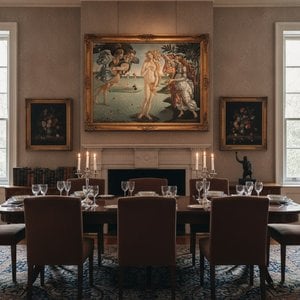
This wasn’t merely about applying decorative elements; it was a holistic approach to design, encompassing not only buildings but also their interiors, furniture, and ornamental details. Adam's theory of “movement” in architecture emphasized harmonious transitions between spaces, creating a sense of flow and unity that was revolutionary for its time. He moved away from the heavy ornamentation and dramatic contrasts of Baroque, favoring lighter colors, delicate plasterwork featuring swags, garlands, and classical figures, and an overall emphasis on symmetry and balance. Key features included:
- Emphasis on symmetry and balance in composition.
- Use of delicate ornamentation derived from classical sources.
- Integration of architecture with interior design to create cohesive spaces.
- A focus on creating a sense of harmony, flow, and refined elegance.
Landmark Creations and Enduring Influence
Robert Adam’s architectural legacy is etched into the British landscape through numerous significant buildings. Dumfries House stands as one of his earliest major commissions, showcasing the nascent elements of the emerging Adam style. Hopetoun House benefited from extensive renovations and interior designs that exemplified his meticulous attention to detail. Fort George demonstrated his capability in large-scale practical building projects. Syon House underwent a remarkable transformation under his guidance, while Kedleston Hall saw him extensively redesign both its interiors and facades. Kenwood House remains a testament to his ability to create elegant and harmonious spaces. Beyond individual structures, Adam’s influence extended to town planning, most notably in his designs for Charlotte Square in Edinburgh – a masterful example of urban design that continues to define the city's aesthetic character. He also served as Member of Parliament for Kinross-shire from 1768 to 1774, demonstrating an engagement with public life alongside his artistic pursuits. Robert Adam passed away on March 3rd, 1792, leaving behind a profound and lasting impact on Western architecture and design. His work not only shaped the aesthetic landscape of Britain but also resonated across Europe and North America, solidifying his position as a pivotal figure in the Neoclassical revival – an architect whose vision continues to inspire and captivate generations.



 Visualizar em escala
 Alternar para Impressão
 Enviar
 Compartilhar
 Ver detalhes
 Guia de Obras do Aluno

 Baixar imagem
 Semelhantes
 Raio X
 Apresentação de slides
 Estatísticas
 Ver mais






































 A opção de vidro está disponível apenas para tamanhos inferiores a 110 cm