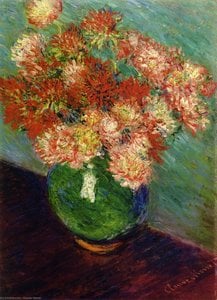
Pierre-Auguste Renoir’s “Gladiolas and Dahlias”: A Symphony of Light and Fragility
Within the vibrant tapestry of Impressionist art lies Pierre-Auguste Renoir's "Gladiolas and Dahlias," a 1918 masterpiece that transcends mere botanical depiction to become a poignant meditation on beauty, transience, and the delicate dance between light and color. Created during a period of personal reflection at Villa Flora in Switzerland, this painting isn’t simply a still life; it's an intimate portrait of a moment captured with Renoir’s signature warmth and luminous technique. The scene unfolds with quiet elegance: a simple table bearing a vase overflowing with the rich hues of gladiolas and dahlias, their velvety petals radiating against a subtly textured background. It’s a composition that invites contemplation, drawing the viewer into a world of delicate beauty and fleeting moments.
Renoir's mastery lies not just in his ability to render flowers with astonishing detail – each petal meticulously painted, capturing its unique texture and form – but also in his masterful manipulation of light. He employs broken brushstrokes, layering colors to create an almost shimmering effect, mimicking the way sunlight filters through a window and dances across surfaces. The blues of the vase are particularly striking, not as flat planes but as complex mixtures that suggest depth and movement. Notice how he uses highlights to draw attention to the vibrant reds of the flowers, creating a visual focal point that anchors the composition while simultaneously allowing the eye to wander amongst the blooms.
The Artistic Vision: Renoir’s Embrace of Everyday Beauty
Renoir's approach to painting was deeply rooted in his belief that beauty could be found in the most ordinary aspects of life. Unlike many of his contemporaries who focused on grand historical scenes or mythological subjects, he turned his attention to the pleasures of Parisian daily life – a café scene, a dance hall, or, as here, a simple arrangement of flowers. This commitment to capturing the essence of everyday experience is evident in “Gladiolas and Dahlias,” which elevates a commonplace subject into something extraordinary through Renoir’s skilled observation and artistic sensibility. He wasn't simply painting flowers; he was painting the *feeling* of their beauty, the way they interact with light, and the quiet joy they evoke.
The choice of gladiolas and dahlias themselves is significant. These flowers, known for their dramatic colors and elegant forms, were popular subjects in still life paintings during this period. They represent a fleeting moment of perfection, mirroring the ephemeral nature of beauty itself. The long stems extending outwards from the vase create a sense of movement and vitality, as if the flowers are reaching towards the light. This dynamic element contrasts with the overall stillness of the composition, suggesting a delicate balance between permanence and transience.
Historical Context: Switzerland in 1918
Painted in 1918, amidst the aftermath of World War I—a period marked by profound societal upheaval and immense grief—"Gladiolas and Dahlias" offers a poignant respite from the anxieties of the time. Renoir’s decision to depict this serene tableau wasn't merely aesthetic; it reflected a desire for solace and contemplation in the face of adversity. Villa Flora, his retreat in Switzerland, provided an ideal setting for capturing this mood of quiet beauty—a deliberate counterpoint to the turbulent events unfolding across Europe.
The Impressionist movement itself was undergoing considerable evolution during Renoir’s lifetime. Artists like Monet and Manet had pioneered techniques that challenged traditional academic conventions, prioritizing optical perception over meticulous representation. Renoir skillfully built upon these innovations, furthering the exploration of color and light—elements central to capturing the immediacy of experience.
A Legacy of Luminosity: Why Renoir Matters
"Gladiolas and Dahlias" stands as a testament to Renoir’s enduring legacy—a symbol of Impressionism's unwavering celebration of beauty, light, and the simple joys of life. His masterful brushwork and luminous palette continue to inspire artists today, demonstrating that profound artistic expression can emerge from seemingly unassuming subjects. The painting reminds us to appreciate the fleeting moments of grace that punctuate our daily lives.
WahooArt offers meticulously crafted, hand-painted oil painting reproductions of “Gladiolas and Dahlias,” allowing you to bring this iconic artwork into your home or office. Our skilled artists replicate Renoir’s delicate brushwork and luminous color palette with exceptional accuracy, creating a faithful representation that captures the essence of the original masterpiece. We also offer high-quality prints on canvas and paper, providing a range of options to suit your individual style and budget.
For those interested in exploring more works by Pierre-Auguste Renoir, we invite you to visit Pierre Auguste Renoir: Gladiolas and Dahlias on WahooArt.com. You can also explore related works by Renoir, such as his portraits of Parisian women or his scenes of the Moulin de la Galette, available at Pierre Auguste Renoir’s Artworks on WahooArt.com. Furthermore, consider visiting the Kunstmuseum Bern in Switzerland, which houses a remarkable collection of German and international art, including works by Renoir himself – accessible through Discovering the Kunstmuseum Bern, Switzerland.



 Visualizar em escala
 Encomendar reprodução pintada à mão
 Enviar
 Compartilhar
 Ver detalhes
 Guia
Guia

 Baixar imagem
 Semelhantes
 Raio X
 Apresentação de slides
 Estatísticas

 Ver mais






































 A opção de vidro está disponível apenas para tamanhos inferiores a 110 cm