A Tranquila Sinfonia de Inverno em Paris: "Boulevard de Clichy" de Paul Signac
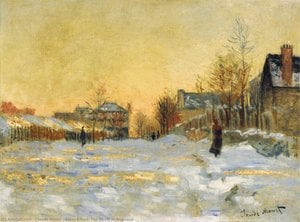
Paul Signac’s “Boulevard de Clichy 1886” isn't merely a depiction of a Parisian street; it’s an invitation to step into a moment of profound tranquility. Painted in the heart of 1886, during his fervent engagement with Neo-Impressionism, this artwork captures the quiet beauty of a winter’s day on the iconic Boulevard de Clichy – a scene that resonates with a serene stillness rarely found within the bustling metropolis. The painting immediately draws the eye to its central focus: a snow-covered street, rendered with meticulous precision and an almost scientific approach to color and light.
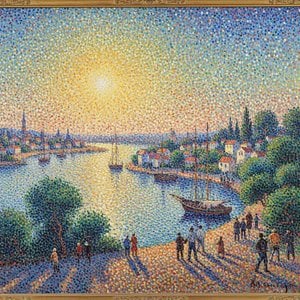
Signac’s genius lies in his masterful deployment of Pointillism, a technique he pioneered alongside Georges Seurat. Instead of blending colors directly on the canvas, he meticulously applied thousands of tiny, distinct dots – minuscule fragments of pure pigment – creating an optical illusion that allows the viewer's eye to blend them together. This isn’t simply a stylistic choice; it represents a deliberate attempt to understand and replicate the way light interacts with our visual perception. The visible brushstrokes, though subtle, contribute to a sense of movement and vitality within the scene’s overall stillness – as if the snow itself is shimmering with reflected light.
A Palette of Cool Reflections: Color and Composition
The color palette of “Boulevard de Clichy” is dominated by a symphony of cool tones—whites, blues, and grays—evoking the crispness and clarity of a winter’s day. These foundational hues are skillfully punctuated with warmer accents – browns, reds, and yellows – strategically placed to highlight architectural details like building facades and street lamps. This careful balance prevents the scene from becoming overly bleak, instead creating a harmonious contrast that draws attention to the textures and forms within the composition.
Signac’s use of linear perspective is equally impressive. He employs it with precision, guiding the viewer's eye down the boulevard and into the distance. The buildings lining the street act as anchors, providing a stable framework for the scene while the leafless trees add vertical elements that contribute to the sense of depth. The flattened perspective, characteristic of Impressionism, subtly enhances the atmospheric effect, suggesting a hazy, dreamlike quality to the winter landscape.
Historical Context and Artistic Innovation
"Boulevard de Clichy 1886" is deeply rooted in the Neo-Impressionist movement, a period marked by a desire to ground artistic practice in scientific principles. Signac’s collaboration with Seurat was pivotal in developing Pointillism, transforming it from a mere technique into a philosophical approach to painting. This wasn't simply about creating visually striking images; it was an attempt to understand and represent the very nature of light and color as perceived by the human eye.
The artwork reflects the artists’ fascination with capturing the effects of light and color in urban landscapes, a subject that had previously been largely ignored. The choice of the Boulevard de Clichy itself – a vibrant hub of Parisian life – adds another layer of interest, juxtaposing the tranquility of winter with the energy of the city.
Symbolism and an Evocative Mood
The snowy landscape within “Boulevard de Clichy” transcends mere representation; it symbolizes tranquility, peace, and a quiet beauty found amidst the chaos of urban life. The presence of pedestrians suggests that even in this serene setting, life continues to unfold – a subtle reminder of humanity’s enduring connection with nature. The painting evokes a contemplative mood, inviting viewers to pause and appreciate the simple elegance of a winter's day.
This artwork is more than just a beautiful image; it’s a testament to Signac’s innovative approach to color and light, his dedication to scientific principles, and his ability to capture the essence of Parisian life. A high-quality reproduction allows you to bring this tranquil scene into your home, offering a moment of serenity and artistic inspiration.



 Visualizar em escala
 Encomendar reprodução pintada à mão
 Enviar
 Compartilhar
 Ver detalhes

 Baixar imagem
 Semelhantes
 Raio X
 Apresentação de slides
 Estatísticas


 Ver mais






































 A opção de vidro está disponível apenas para tamanhos inferiores a 110 cm