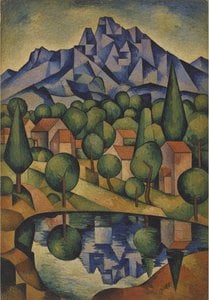
Still Life with Pomegranate and Pears: A Study in Form and Color
Paul Cézanne's Still Life with Pomegranate and Pears, painted around 1890, is more than just a depiction of fruit; it’s a profound exploration of form, color, and the artist’s evolving approach to representing reality. This oil on canvas masterpiece, now residing in The Phillips Collection, exemplifies Cézanne's transition from Impressionism towards his groundbreaking Cubist innovations. It showcases his meticulous observation and deliberate manipulation of perspective, laying the groundwork for future artistic revolutions.
Composition and Technique: Building Blocks of Perception
The painting presents a seemingly simple arrangement – apples, pears, and a pomegranate displayed on a table alongside a bowl and chair. However, Cézanne’s technique transforms this ordinary scene into something extraordinary. He employs a methodical approach, breaking down the objects into geometric forms—cones, cylinders, and spheres—and reconstructing them on the canvas. Notice the deliberate use of planes of color; rather than blending smoothly, colors are applied in distinct brushstrokes, creating a textured surface that vibrates with energy. The perspective is not traditional; Cézanne subtly distorts it to emphasize the spatial relationships between objects, challenging conventional notions of depth and realism. This technique foreshadows the fragmentation and multiple viewpoints characteristic of Cubism.
Historical Context: Post-Impressionism and the Dawn of Modern Art
Still Life with Pomegranate and Pears emerged during a pivotal period in art history—the late 19th century, as Impressionism began to wane. Cézanne, along with artists like Van Gogh and Gauguin, spearheaded Post-Impressionism, moving beyond the fleeting impressions of light and color that defined Impressionism. Instead, they sought to explore deeper truths about form, structure, and emotional expression. Cézanne’s work was initially met with criticism and misunderstanding; however, his influence on subsequent generations of artists—particularly Picasso and Matisse—is undeniable. He is now recognized as a crucial bridge between the 19th-century artistic tradition and the radical innovations of the 20th century.
Symbolism and Emotional Resonance
While seemingly devoid of overt symbolism, Cézanne’s still life evokes a sense of quiet contemplation and enduring presence. The fruit themselves—the pomegranate, with its abundance of seeds symbolizing fertility and prosperity; the pears, representing ripeness and nourishment; and the apples, often associated with knowledge and temptation—contribute to the painting's rich visual vocabulary. More importantly, Cézanne’s deliberate rendering of these everyday objects elevates them to a level of timeless beauty. The painting invites viewers to appreciate the inherent structure and form within the mundane, prompting a deeper engagement with the world around us. It is not merely an image of fruit; it is an exploration of perception itself—a testament to Cézanne’s unwavering commitment to understanding and representing reality in his own unique way.
Legacy and Enduring Appeal
Still Life with Pomegranate and Pears stands as a cornerstone of Post-Impressionist art, demonstrating Cézanne's revolutionary approach to painting. Its influence can be seen throughout the development of modern art, inspiring countless artists to challenge conventions and explore new ways of seeing. The painting’s enduring appeal lies in its ability to simultaneously captivate with its beauty and provoke thought about the nature of representation—a testament to Cézanne’s genius and his lasting contribution to the world of art.
The Phillips Collection's acquisition of this artwork solidified its place within the canon of modern art. Its meticulous attention to detail, combined with Cézanne’s innovative use of color and form, continues to fascinate scholars and artists alike. The painting serves as a reminder that beauty can be found in simplicity—a profound statement about artistic vision and its ability to transcend time.
Considered by many as the father of Cubism alongside Picasso and Matisse, Cézanne’s legacy extends far beyond this single masterpiece. His pioneering techniques paved the way for new artistic movements and fundamentally altered our understanding of how art communicates emotion and explores visual reality.



 Visualizar na parede
 Alternar para Impressão
 Compartilhar
 Compartilhar
 Detalhes

 Baixar imagem
 Semelhantes
 Raio X
 Slideshow
 Estatísticas

 Ler mais






































 A opção de vidro está disponível apenas para tamanhos inferiores a 110 cm