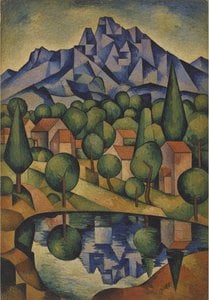
The Rum Punch: A Window into Cézanne’s Romantic Soul
Paul Cézanne's “The Rum Punch,” painted in 1867, isn’t merely a depiction of two women; it’s a carefully constructed tableau brimming with unspoken narratives and a profound exploration of the human experience. Created during a pivotal period in his artistic development, this watercolor offers a glimpse into the burgeoning Romanticism that would later give way to the revolutionary forms of Post-Impressionism. More than just a snapshot, it's an invitation to contemplate intimacy, vulnerability, and the subtle power dynamics at play within a domestic scene.
The painting immediately draws the eye with its muted palette—a symphony of browns, ochres, and deep greens—creating an atmosphere of quiet contemplation. The figures are bathed in a soft, diffused light, suggesting either twilight or the shaded interior of a room. Two women occupy the space: one, positioned centrally, leans towards the other, her hand gently resting on the woman’s face. This gesture is both tender and subtly possessive, hinting at a complex relationship—perhaps one of affection, perhaps something more layered and nuanced. The woman receiving the touch wears a vibrant red dress, a bold splash of color that immediately commands attention and adds an element of dramatic intensity to the scene.
Composition and Technique: A Dance of Form
Cézanne’s masterful use of watercolor is evident in every brushstroke. He employs loose, expressive strokes—a hallmark of his evolving style—to capture the textures of fabric, skin, and the surrounding environment. Notice how he builds up layers of color to create a sense of depth and volume, particularly in the draped curtain that partially obscures the background. The painting’s composition is deliberately asymmetrical, with the figures positioned off-center, contributing to a feeling of unease and inviting the viewer to actively engage with the scene.
The artist's technique isn't simply about replicating what he sees; it’s about distilling the essence of his subject. He uses broken color—applying small, distinct patches of pigment rather than blending them seamlessly—to create a shimmering effect and suggest movement within the painting. The shadows are particularly evocative, rendered with delicate washes that seem to breathe life into the figures and their surroundings. The careful attention to detail in depicting the folds of the dress and the texture of the skin demonstrates Cézanne’s growing interest in capturing the underlying structure of objects—a precursor to his later explorations of geometric forms.
Romanticism, Symbolism, and a Hint of Mystery
“The Rum Punch” firmly resides within the Romantic tradition, prioritizing emotion and imagination over strict realism. The scene itself is imbued with a sense of mystery and intrigue. What transpired before this moment? What will happen next? The cats scattered throughout the room—a common motif in Cézanne’s work—add to the painting's enigmatic quality. They are not merely decorative elements; they seem to be witnesses to the unfolding drama, adding an element of playful chaos and hinting at a hidden world beneath the surface.
The title itself, “The Rum Punch,” is deliberately ambiguous. It could refer to a literal drink shared between the women, or it might symbolize something more profound—a shared secret, a moment of intoxication, or perhaps even a metaphor for the complexities of human relationships. Cézanne’s deliberate use of symbolism invites viewers to interpret the painting through their own emotional lens.
A Legacy of Innovation
“The Rum Punch” represents a crucial turning point in Cézanne's artistic journey, bridging the gap between his earlier influences and his groundbreaking innovations. It foreshadows his later explorations of form, color, and perspective—elements that would profoundly influence generations of artists to come. This painting is not just a beautiful work of art; it’s a testament to Cézanne’s visionary approach to representation and his enduring legacy as one of the most important figures in modern art. Reproductions of this evocative piece offer a unique opportunity to bring this captivating scene into your home, allowing you to contemplate its mysteries and appreciate the genius of Paul Cézanne.
Perguntas e Respostas
Como é descrita a paleta de "The Rum Punch" de Paul Cézanne?
As cores de "The Rum Punch" formam uma paleta Earthy. Esta classificação descreve as famílias de cores dominantes.
Qual é a saturação de cor de "The Rum Punch" de Paul Cézanne?
"The Rum Punch" de Paul Cézanne é registrado com uma saturação de Subtle Color.
Para qual ambiente "The Rum Punch" de Paul Cézanne é recomendado?
O espaço recomendado para "The Rum Punch" de Paul Cézanne é uma Living Room. A sugestão pode, naturalmente, ser adaptada ao seu interior.



 Visualizar em escala
 Encomendar reprodução pintada à mão
 Enviar
 Compartilhar
 Ver detalhes
 Guia de Obras do Aluno

 Baixar imagem
 Semelhantes
 Raio X
 Apresentação de slides
 Estatísticas

 Ver mais






































 A opção de vidro está disponível apenas para tamanhos inferiores a 110 cm