A Glimpse into Childhood: Unveiling Cézanne’s “Child in a Straw Hat”
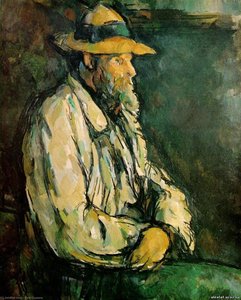
Paul Cézanne's *Child in a Straw Hat*, painted in 1902, is more than just a portrait; it’s a pivotal work embodying the transition from Impressionism to the revolutionary artistic landscape of the early 20th century. This painting captures a young woman – often believed to be Cézanne’s daughter Marie – seated comfortably, her hands gently folded in her lap, adorned with a simple straw hat. The scene exudes an intimate tranquility that draws the viewer into a moment of quiet contemplation.
The Dawn of Post-Impressionism
Cézanne is rightfully celebrated as a foundational figure of Post-Impressionism, a movement rejecting the limitations of merely capturing fleeting impressions of light and instead focusing on subjective vision and deeper structural qualities. Unlike the airy lightness of Impressionism, Cézanne sought to represent the underlying geometric forms of nature, paving the way for Cubism and other abstract movements. *Child in a Straw Hat* exemplifies this shift; it’s not simply *what* is seen but *how* it's perceived and reconstructed on canvas that takes precedence. The painting stands as a testament to Cézanne’s dedication to exploring form, color, and composition with unprecedented boldness.
Technique & Style: A Masterclass in Brushwork
Cézanne’s distinctive technique is immediately apparent. He employs
bold brushstrokes, applied with a deliberate density that creates a palpable texture. These aren't blended to create smooth transitions; instead, they stand as individual marks contributing to the overall structure and volume of the figure. The use of color is equally striking – warm pinks in the complexion contrast beautifully with the muted tones of the dress and hat. He masterfully uses
geometric shapes to build form, subtly breaking down the subject into planes and angles. This approach anticipates the fragmented forms that would become central to Cubism. The background is deliberately indistinct, serving to focus attention on the figure and her internal state.
Symbolism & Emotional Resonance
While seemingly straightforward, *Child in a Straw Hat* carries subtle symbolic weight. The straw hat itself evokes notions of rural life, simplicity, and perhaps even innocence. The subject’s relaxed posture and gentle gaze suggest a sense of peace and contentment. However, Cézanne's deliberate distortions and unconventional brushwork prevent the painting from becoming overly sentimental. Instead, it conveys a complex emotional landscape – a blend of tenderness, observation, and intellectual rigor. The work isn’t about portraying a specific personality but rather exploring universal themes of human presence and perception.
Cézanne's Legacy & Collecting Today
*Child in a Straw Hat* is not merely a beautiful painting; it’s a crucial link in the history of modern art. Its influence can be seen in the works of countless artists who followed, from Picasso and Braque to Matisse and beyond. Owning a high-quality reproduction allows you to bring a piece of this artistic heritage into your home or office. The painting's calming presence and sophisticated aesthetic make it an ideal addition to any collection, complementing both traditional and contemporary interiors. Like other masterpieces by Cézanne, such as *Peaches, Pears and Grapes*, it continues to inspire awe and provoke thought, solidifying his place as one of the most influential artists of all time.
A testament to the power of observation and the enduring beauty of form.
- Paul Cézanne’s *Child in a Straw Hat* embodies the transition from Impressionism to Post-Impressionism.
- The painting is characterized by bold brushstrokes, geometric forms, and a focus on subjective perception.
- Subtle symbolism within the work evokes themes of innocence, simplicity, and inner peace.
- Cézanne’s innovative techniques profoundly influenced the development of modern art.



 Visualizar na parede
 Comprar impressão
 Compartilhar
 Compartilhar
 Detalhes

 Baixar imagem
 Semelhantes
 Raio X
 Slideshow

 Ler mais






































 A opção de vidro está disponível apenas para tamanhos inferiores a 110 cm