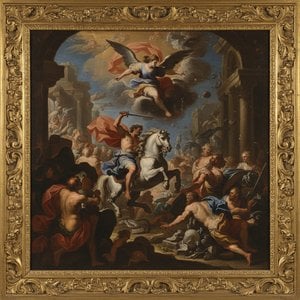
A Tempest of Clay and Light: Unveiling Poussin’s “The Rape of the Sabine Women”
Nicolas Poussin's two masterful depictions of "The Rape of the Sabine Women" stand as monumental testaments to his extraordinary ability—a rare confluence of rigorous historical study, profound emotional depth, and Baroque theatricality. More than mere illustrations of a foundational myth in Roman history, these paintings are complex meditations on conflict, power dynamics, and the very genesis of an empire built upon a foundation of violence and uneasy integration. These works, one residing within the hallowed halls of the Metropolitan Museum of Art in New York City, and the other gracing the walls of the Louvre in Paris, invite us to confront not just a dramatic scene, but also the unsettling questions it raises about civilization itself. Poussin doesn’t simply record an event; he dissects its moral implications with a sensitivity rarely matched by his contemporaries.
The story at the heart of these paintings—the abduction of Sabine women by Romulus and his followers—is a cornerstone of Roman mythology, a narrative that shaped the city's identity and justified its expansion. Initially, Rome’s burgeoning male population faced a critical shortage of wives, threatening the future of the nascent republic. Romulus, driven by necessity and ambition, orchestrated a festival designed to attract potential brides from neighboring tribes, notably the Sabines. However, this well-intentioned strategy quickly devolved into an act of aggression—a brazen violation of Sabine sovereignty that ignited a protracted war. Poussin masterfully captures not just the physical action but also the underlying tension: the desperate need for survival juxtaposed with the brutal methods employed to achieve it.
A Baroque Masterpiece Forged in Classical Principles
Poussin’s style, while firmly rooted within the Baroque period, distinguishes itself through a remarkable restraint and intellectual clarity. Unlike the often-overwhelming dynamism characteristic of artists like Bernini or Caravaggio, Poussin prioritizes order, proportion, and a meticulous attention to detail that echoes the ideals of classical antiquity. He doesn't abandon the dramatic flair of the Baroque—the intense chiaroscuro (the stark contrast between light and shadow) is undeniably present—but he employs it with a calculated precision, guiding the viewer’s eye through a carefully constructed composition. The paintings are built upon a powerful pyramidal structure, drawing our attention to key figures: Romulus issuing his command, the terrified yet defiant Sabine women, and the clashing warriors locked in mortal combat. This deliberate arrangement imbues the scene with a sense of stability amidst chaos, reflecting Poussin’s belief that beauty and order could be found even within turbulent events.
The Dance of Light and Shadow: Technique and Materiality
Executed in oil on canvas (104 x 210 cm for the 1634 version), Poussin's technique is a testament to his mastery. He builds form not through bold brushstrokes, but through subtle gradations of light and shadow—a painstaking layering of paint that creates an astonishing sense of depth and volume. The textures are remarkably varied: the smooth surfaces of skin contrast sharply with the rougher depiction of armor and the weathered stone architecture in the background. The color palette is predominantly warm – dominated by earthy browns, ochres, and reds – punctuated by flashes of cool blues and whites that heighten the drama. Poussin’s meticulous attention to anatomical detail, informed by his deep understanding of classical sculpture, lends a remarkable sense of realism to the scene, despite its fantastical subject matter. The paintings are not merely representations; they are carefully constructed illusions, inviting us to lose ourselves in their intricate details.
Symbolism and the Echoes of History
Beyond the literal depiction of abduction, Poussin’s “Rape of the Sabine Women” resonates with profound symbolic meaning. Romulus's forceful gesture embodies authority and the assertion of Roman power—a power born from conquest and fueled by a willingness to resort to violence. The Sabine women, caught between resistance and resignation, represent both victimhood and the potential for cultural integration – a poignant reminder that Rome’s rise was inextricably linked to the subjugation of other peoples. The expressions on their faces—ranging from anguish and despair to a flicker of defiance—evoke a powerful emotional response, forcing us to confront the brutality inherent in the founding myth. The inclusion of details like the Sabine children, vulnerable and exposed, further amplifies the painting’s tragic impact.
A Legacy Enduring Through Reproduction
Poussin's “The Rape of the Sabine Women” remains a cornerstone of Western art history, profoundly influencing generations of artists from Jacques-Louis David to Paul Cézanne. Today, these paintings continue to inspire awe and provoke contemplation, serving as powerful reminders of the complex origins of civilization and the enduring themes of conflict, power, and human suffering. For collectors and interior designers, a high-quality reproduction offers not only a visually stunning centerpiece—a work steeped in history, artistry, and profound emotional depth—but also a conversation starter, a window into a pivotal moment in Roman history and a testament to the genius of Nicolas Poussin. The paintings’ balanced composition and restrained palette make them surprisingly versatile, complementing both traditional and contemporary interiors.
- Artist: Nicolas Poussin (1594-1665)
- Date: 1634 (Metropolitan Museum of Art version)
- Medium: Oil on canvas
- Dimensions: 104 x 210 cm
- Style: Baroque, Classical
Photo Description: --Overall Impression-- The artwork depicts a chaotic and dramatic scene of battle or conflict, likely inspired by classical history. It’s a large-scale composition dominated by numerous figures engaged in violent action. The style leans towards Baroque, characterized by dynamic movement, intense emotion, and theatrical lighting. The perspective is somewhat flattened, creating a sense of immediacy and drawing the viewer into the heart of the struggle. The subject matter centers around Roman soldiers and civilians caught in a tumultuous event – possibly a siege or a revolt. There’s a central figure, presumably a leader or orator, elevated on a platform, gesturing emphatically. The composition is pyramidal, with the leader at the apex and the mass of combatants forming the base. Lines are used to define the musculature of the figures, creating a sense of volume and realism. Shapes are predominantly organic – bodies, weapons, shields – contributing to the overall dynamism. Textures appear to be rendered through brushwork, suggesting both smooth surfaces (like clothing) and rougher areas (like skin and stone architecture). Lighting is dramatic and directional, highlighting key figures and adding to the scene’s intensity. Symbolically, the image likely represents themes of power, conflict, and human suffering.



 Visualizar em escala
 Alternar para Impressão
 Enviar
 Compartilhar
 Ver detalhes
 Guia
Guia

 Baixar imagem
 Semelhantes
 Raio X
 Apresentação de slides
 Estatísticas


 Ver mais






































 A opção de vidro está disponível apenas para tamanhos inferiores a 110 cm