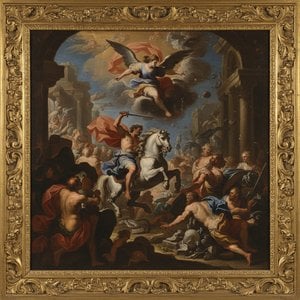
A Tempestuous Vision of Ruin: Poussin’s “The Destruction of the Temple at Jerusalem”
Nicolas Poussin's "The Destruction of the Temple at Jerusalem," painted in 1637, isn’t merely a historical depiction; it’s a profoundly moving exploration of loss, chaos, and the enduring weight of human conflict. This monumental oil on canvas, now housed within the Kunsthistorisches Museum in Vienna, transcends its subject matter to become a universal meditation on destruction and the fragility of civilization. Poussin, already establishing his signature style—a masterful blend of Italian sensuality with classical restraint—here delivers a scene of unparalleled drama and emotional intensity.
The painting captures a pivotal moment during the Jewish War (66-70 AD), specifically the Roman siege and subsequent destruction of Jerusalem’s Second Temple. We witness not just an event, but its immediate aftermath: soldiers on horseback, clad in gleaming armor, clash with desperate defenders wielding swords and shields. The composition is deliberately complex, a carefully orchestrated tableau of violence and terror. Poussin doesn't shy away from the brutality; instead, he presents it with a controlled elegance, utilizing a dramatic interplay of light and shadow—a hallmark of his *chiaroscuro* technique—to heighten the sense of urgency and despair. The figures are rendered with meticulous detail, each face etched with anguish or determination, contributing to the overwhelming feeling of chaos.
The Language of Baroque Drama
Poussin’s mastery lies not just in his realistic depiction but in his ability to infuse the scene with a powerful emotional resonance. The background, shrouded in smoke and flames, hints at the temple's fiery demise—a visual metaphor for the loss of faith and spiritual center. Notice how Poussin employs a pyramidal composition, drawing our eye upwards towards the burning structure, creating a sense of inevitable doom. The use of color is equally significant; the reds and oranges of the fire contrast sharply with the muted blues and grays of the soldiers’ armor, further emphasizing the destructive force at play. The artist's brushstrokes are visible, adding to the texture and dynamism of the scene—a deliberate departure from the smooth, polished surfaces favored by some of his contemporaries.
Historical Echoes and Classical Allusions
“The Destruction of the Temple” is part of a larger series commissioned by Cardinal Francesco Barberini, exploring themes of conquest and loss. This particular work resonates deeply with Poussin’s earlier painting, “The Conquest of Jerusalem by Emperor Titus,” creating a compelling dialogue between the events themselves and their symbolic implications. Poussin wasn't simply documenting history; he was engaging with its moral complexities. The figure of Titus, depicted in the earlier piece, embodies imperial power and ruthless efficiency—a stark contrast to the suffering of the besieged city. Here, Poussin subtly shifts the focus, highlighting the human cost of conflict and questioning the justifications for conquest.
A Timeless Masterpiece: Reproduction and Legacy
The original painting remains a treasured possession of the Kunsthistorisches Museum, protected within its climate-controlled galleries. However, WahooArt.com offers exquisite, hand-painted oil reproduction reproductions that capture the essence of Poussin’s masterpiece with remarkable fidelity. These aren't mere copies; they are lovingly crafted works of art in their own right, meticulously recreating the artist’s color palette, brushwork, and compositional balance. Owning a reproduction allows you to bring this powerful image into your home or office—a testament to both artistic genius and enduring historical significance. Consider it not just a decoration, but a window into a pivotal moment in history, a poignant reminder of the destructive potential of human conflict, and a celebration of Poussin’s unparalleled skill.
For more information on Nicolas Poussin and his works, including the Hofmuseum Vienna, please visit WahooArt.com.



 Visualizar em escala
 Encomendar reprodução pintada à mão
 Enviar
 Compartilhar
 Ver detalhes

 Baixar imagem
 Semelhantes
 Raio X
 Apresentação de slides
 Estatísticas


 Ver mais






































 A opção de vidro está disponível apenas para tamanhos inferiores a 110 cm