Adquira uma imagem digital de alta resolução e aprimorada, muito superior à prévia online.
Cada arquivo é meticulosamente preparado por nossos especialistas internos, utilizando ferramentas avançadas e retoques manuais de alta precisão. Garantimos que cada imagem apresente clareza excepcional, fidelidade de cores e detalhes minuciosos.
O arquivo final é entregue por e-mail em até 72 horas, otimizado para uso imediato em ambientes profissionais, editoriais e de impressão. Esta é a mesma qualidade utilizada por estúdios de design de alto nível, editoras e galerias.
Baixe um arquivo de alta resolução para exibição pessoal, impressão e projetos criativos. ( Comprar impressão Comprar pintura feita à mão)
Ao escolher o WahooArt.com, você não está apenas adquirindo uma imagem — você está recebendo uma obra de arte digital profissionalmente aprimorada, elaborada com precisão e com garantia de satisfação. Aqui está tudo o que acompanha seu pedido, automaticamente:

O seu arquivo de imagem digital em alta resolução será enviado por e-mail em até 72 horas após o pedido — pronto para uso imediato.

Sua obra de arte é otimizada profissionalmente por meio de ferramentas avançadas de IA e edição manual, garantindo o máximo de detalhes, clareza e precisão de cores.

Apagou ou perdeu o seu ficheiro acidentalmente? Não se preocupe – nós reenviamos para si a qualquer momento, gratuitamente.

Desfrute da sua obra de arte instantaneamente, sem taxas alfandegárias, impostos ou custos de entrega — downloads digitais são sempre isentos de taxas.

Garantimos que sua imagem digital reflita as cores originais com a maior fidelidade possível, utilizando ferramentas profissionais e gerenciamento de cores.

Se você não estiver satisfeito com sua imagem digital, nós a revisaremos ou reembolsaremos 100% dentro de 100 dias — sem perguntas.

Não está satisfeito? Receba o reembolso total em até 100 dias após o recebimento do seu arquivo digital — sem perguntas.

Compre 3 imagens, economize 10% - Compre 5, economize 15% - Compre 10+, economize 20%. Ideal para projetos criativos, galerias e agências.

In the vibrant, bustling landscape of the Dutch Golden Age, few artists captured the dramatic tension of the Baroque era with as much meticulous care as Nicolaes Knüpfer. Born in Leipzig, Germany, in 1609, Knüpfer’s journey from a German apprentice to a celebrated figure in the Dutch artistic community is a testament to the fluid, interconnected nature of European art in the seventeenth century. His early years were defined by a rigorous pursuit of technical mastery, beginning with his training under the esteemed Emanuel Nysen. This foundational period instilled in him a profound respect for the structural elements of painting, but it was perhaps his unexpected tenure in Magdeburg that truly shaped his unique artistic DNA. While residing there, Knüpfer worked as a brushmaker, an intimate occupation that granted him an unparalleled understanding of the tools of his trade. This rare insight into the very fibers and textures of the brush allowed him to manipulate pigments with a precision that would later become his hallmark, blending the artisan's tactile knowledge with the painter's visionary spirit.
The trajectory of Knüpfer’s career reached a transformative milestone in 1630 when he relocated to Utrecht. This move placed him at the heart of a flourishing artistic hub, where he entered into a pivotal collaborative partnership with the legendary Abraham Bloemaert. Under the influence of Bloemaert’s sophisticated style, Knüpfer began to expand his repertoire beyond mere technical execution, embracing the grander, more emotive themes of biblical narratives and mythological legends. His ability to weave complex stories through flowing lines and unusual, expressive figures set him apart from his contemporaries. By 1637, his reputation was firmly established, earning him prestigious membership in the Guild of St. Luke. This period of professional maturity saw him undertaking monumental commissions that extended far beyond the borders of the Netherlands; notably, his work for the opulent Kronborg Castle in Denmark serves as a glittering reminder of his status as a premier decorative artist capable of enriching the most royal of interiors.
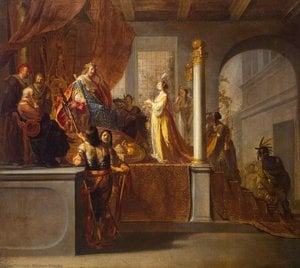
Knüpfer’s body of work is characterized by a remarkable versatility, allowing him to navigate seamlessly between the divine and the earthly. He possessed a singular talent for breathing life into historical and biblical figures, imbuing them with a sense of psychological depth and grandeur. In masterpieces such as Queen of Sheba before Solomon, one can witness his mastery of the Baroque aesthetic—a world of rich textures, dramatic lighting, and courtly splendor that transports the viewer to an era of ancient majesty. Yet, Knüpfer was equally adept at capturing the gritty, spirited atmosphere of everyday life. His genre paintings, such as the evocative Brothel Scene, reveal a different facet of his genius. In these works, the refined elegance of his mythological scenes gives way to exaggerated characters and expressive brushstrokes that capture the raw, often chaotic energy of an Amsterdam tavern, offering a poignant window into the societal attitudes and textures of the Dutch Golden Age.
Beyond his solo achievements, Knüpfer’s significance is deeply intertwined with the broader movement of landscape and collaborative painting. He frequently collaborated with masters such as Jan Both and Jan Baptist Weenix, skillfully integrating his intricate figures into their expansive, atmospheric landscapes. This synergy created a holistic viewing experience where human drama and natural beauty existed in perfect, dramatic harmony. His legacy is further cemented by his role as a mentor and an influence on the next generation of Dutch masters; the lineage of great painters like Jan Steen and Gabriel Metsu can trace stylistic threads back to the precision and narrative depth pioneered by Knüpfer. Through his blend of artisan craftsmanship and high-art storytelling, Nicolaes Knüpfer remains a vital figure in the history of European art, reminding us of a time when every brushstroke was an act of both devotion and discovery.

1609 - 1655 , Germany

 Visualizar na parede
 Compartilhar
 Compartilhar
 Detalhes

 Baixar imagem
 Semelhantes
 Raio X
 Slideshow
 Ler mais