Transition: A Dialogue Etched in Walls
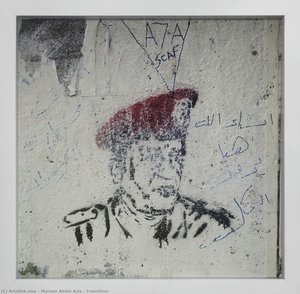
“Transition” by Myriam Abdel Aziz isn’t merely a painting; it's a snapshot of a pivotal moment in Egyptian history – the tumultuous aftermath of President Mubarak’s resignation in February 2011. More than just depicting graffiti art on textured wall, Aziz captures the raw energy and profound division simmering beneath the surface of a nation grappling with its newfound freedom.
The artwork immediately draws the eye to a striking portrait: a military figure rendered in red, dominating the central space. This deliberate choice symbolizes authority – perhaps referencing the role of the armed forces during the revolution and their subsequent influence on shaping Egypt’s trajectory. Surrounding him is a vibrant tapestry of graffiti lettering and markings, executed with spray paint—a technique that lends immediacy and spontaneity to the composition.
Aziz's stylistic approach leans heavily into documentary photography, mirroring her fascination with cinematic storytelling as evidenced by her meticulous recreations of Pakistani film posters like “Aandhi Shakar.” This initial inspiration instilled in her a penchant for dramatic compositions and stylized map designs—elements that continue to inform her artistic vision.
The color palette is predominantly monochromatic, dominated by shades of grey, black, and white. These muted tones underscore the solemnity of the subject matter – the struggle for stability amidst societal upheaval. Subtle variations in tone contribute to a palpable sense of depth and texture within the graffiti layers, enhancing the artwork’s authenticity.
Lines are rough and gestural, characteristic of street art techniques. The shapes are organic and irregular, mirroring the unpredictable nature of social change. Aziz skillfully conveys emotion through visual storytelling, reflecting her commitment to portraying Arab women's stories with sensitivity and nuance—a core ethos championed by Rawiya Collective.
The artwork’s historical context is crucial: graffiti emerged as a form of political expression during Egypt’s transition government, representing the voices of diverse factions vying for influence. The ephemeral quality of spray paint – its tendency to fade over time – serves as a powerful metaphor for the fleeting nature of revolutionary fervor and the enduring quest for societal reform.
“Transition” is more than just an image; it’s a testament to Aziz's artistic prowess and her ability to distill complex narratives into compelling visual representations. It invites contemplation on themes of resilience, division, and the transformative power of collective action—themes that resonate deeply within contemporary art discourse.



 Visualizar em escala
 Encomendar reprodução pintada à mão
 Enviar
 Compartilhar
 Ver detalhes
 Guia
Guia

 Baixar imagem
 Semelhantes
 Raio X
 Apresentação de slides
 Estatísticas


 Ver mais






































 A opção de vidro está disponível apenas para tamanhos inferiores a 110 cm