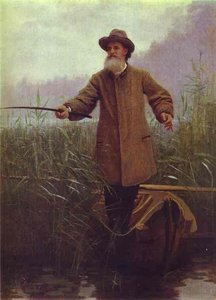
Early Life and Artistic Foundations
Mikhail Vasilyevich Nesterov, born in Ufa on May 31st, 1862, emerged from a family steeped in tradition yet subtly attuned to the currents of intellectual awakening. His father, a draper with a keen interest in history and literature, fostered an environment that nurtured young Mikhail’s sensitivity—a rare encouragement for artistic ambition within the confines of merchant society. While initially steered towards practical skills, Nesterov's innate talent soon became undeniable, leading him to Moscow in 1874 and enrollment at the School of Painting, Sculpture and Architecture. This marked a pivotal shift, placing him under the tutelage of influential figures like Pavel Sorokin, Illarion Pryanishnikov, and Vasily Perov—the latter proving particularly inspiring.
Perov’s emphasis on realism and social commentary resonated deeply with Nesterov, shaping his early artistic explorations. However, a growing dissatisfaction with the Academy's rigid academic approach prompted him to seek alternative paths. His subsequent association with the *Peredvizhniki* (Wanderers), a group dedicated to bringing art directly to the people, broadened his horizons and exposed him to diverse perspectives on Russian life and culture. This period was crucial in establishing Nesterov’s commitment to portraying authentic human experiences, albeit increasingly filtered through a burgeoning spiritual lens.
The Emergence of Mystical Realism
Nesterov's artistic breakthrough arrived with “The Vision of Youth Bartholomew” (1890-1891), a painting that transcended mere historical representation. Depicting the conversion of Saint Sergius of Radonezh, it wasn’t simply an illustration of religious narrative; it was a profound exploration of inner faith and spiritual awakening. This work is widely considered the genesis of Russian Symbolist art, signaling Nesterov's departure from conventional realism towards a more evocative and psychologically charged style.
The 1890s witnessed a deepening fascination with religious themes, fueled by his travels and encounters with monastic life. He sought to capture not just the outward forms of faith but its very essence—the emotional turmoil, the quiet contemplation, the transcendent beauty. This pursuit led him to develop a unique artistic language that blended meticulous technique with an almost iconographic sensibility. His paintings began to radiate a mystical quality, characterized by soft lighting, muted colors, and figures imbued with an ethereal grace.
Key Works and Artistic Characteristics
“The Hermit” (1888) stands as one of Nesterov’s most iconic creations, embodying the core tenets of his artistic vision. The painting depicts an elderly monk lost in serene contemplation amidst a tranquil natural setting. It's not merely a portrait but a meditation on solitude, spiritual devotion, and the search for inner peace. The subtle brushwork, the evocative use of light and shadow, and the profound sense of stillness all contribute to its enduring power.
Other significant works include “Head of a Young Mordvinian” (1889), a captivating portrait showcasing his mastery of expressive realism, and "The Nativity". Throughout his oeuvre, Nesterov consistently demonstrated a remarkable ability to capture the psychological depth of his subjects. His portraits are not simply likenesses; they are windows into the souls of those he depicted.
- Symbolism & Spirituality: A central theme in Nesterov’s work, often exploring religious narratives and inner faith.
- Mystical Realism: Blending meticulous technique with evocative imagery to convey spiritual experiences.
- Lyrical Style: Characterized by soft lighting, muted colors, and a sense of ethereal grace.
- Psychological Depth: Portraits that reveal the inner lives and emotional states of his subjects.
Legacy and Historical Significance
Mikhail Nesterov’s influence on Russian art is profound. He was a pioneer in bridging the gap between realism and symbolism, paving the way for a new generation of artists who sought to explore the spiritual dimensions of human existence. His work resonated deeply with contemporaries like Alexandra Feodorovna, the last Empress of Russia, and her sister Elizabeth, who were drawn to his ability to capture the essence of faith and devotion.
Nesterov’s paintings offer a glimpse into the soul of late 19th-century Russia—a society grappling with modernization, spiritual questioning, and a yearning for meaning. His legacy extends beyond the realm of art; he remains a powerful symbol of artistic integrity, spiritual exploration, and the enduring human quest for transcendence. He continued to paint throughout his life, adapting to changing political climates but never abandoning his core artistic principles. He died in Moscow on October 18th, 1942, leaving behind a body of work that continues to captivate and inspire audiences today.



 Visualizar em escala
 Alternar para Impressão
 Enviar
 Compartilhar
 Ver detalhes
 Guia
Guia

 Baixar imagem
 Semelhantes
 Raio X
 Apresentação de slides
 Estatísticas


 Ver mais