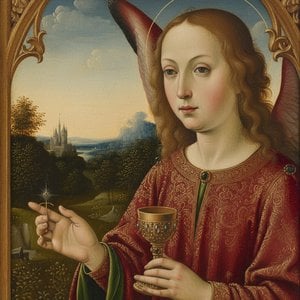
A Moment Suspended in Time: The Intimacy of Memling’s Bathsheba
In the quiet, amber-hued corridors of the Northern Renaissance, few works capture the delicate intersection of human vulnerability and divine grace as poignantly as Hans Memling’s Bathsheba. Painted around 1485 in the flourishing artistic hub of Bruges, this masterpiece transcends a mere biblical illustration to become a profound psychological study. As we gaze upon the scene, we are not merely spectators to a historical narrative; we are invited into a private, sacred sanctuary. The painting depicts Bathsheba, the wife of King David, in a moment of quiet transition within a luxurious bedchamber. There is an unmistakable sense of stillness, a breath held in anticipation, as she kneels before her husband, accepting a robe from a faithful maidservant. It is a tableau that speaks to the very essence of the human condition—the tension between our earthly desires and our spiritual aspirations.
The brilliance of Memling’s technique lies in his ability to marry the meticulous realism of the Early Netherlandish tradition with an almost ethereal luminosity. Utilizing the oil-on-panel method perfected by masters like Jan van Eyck, Memling achieves a textural depth that feels tactile to the modern eye. One can almost sense the weight of the heavy drapery, the coolness of the skin, and the soft, diffused light filtering through the chamber. His use of chiaroscuro—the masterful interplay between shadow and illumination—does more than create three-dimensional form; it directs the viewer's emotional journey, pulling our focus toward the tender interaction between the figures while casting the periphery in a mysterious, contemplative gloom.
Symbolism and the Language of Light
Every element within this composition serves as a silent messenger, contributing to a complex tapestry of meaning. The bedchamber itself is far from a neutral setting; it represents a realm of domestic tranquility and marital harmony, acting as a deliberate, peaceful counterpoint to the moral turmoil found in the biblical account of David’s transgression. The maidservant, poised with grace, serves as a symbol of purity and humble service, her presence anchoring the scene in a sense of ritualistic care. Even the seemingly mundane objects—the delicate vase, the carefully placed bowls, and the sturdy chair in the background—contribute to an atmosphere of settled, bourgeois stability that was characteristic of the Burgundian Netherlands.
For the discerning collector or interior designer, this artwork offers much more than visual beauty; it provides a focal point of profound intellectual and emotional resonance. A high-quality reproduction of Bathsheba brings with it an aura of historical prestige and a sense of quiet sophistication. Whether placed in a sunlit study to inspire deep reflection or within a grand living space to anchor a room with classical elegance, the painting’s soft palette and intricate details command attention without overwhelming the environment. It is a piece that invites the eye to linger, rewarding the viewer with new discoveries of light and shadow upon every encounter, making it an enduring investment for those who value art that speaks to both the eyes and the soul.
Perguntas e Respostas
Qual nível de contraste apresenta "Bathsheba" de Hans Memling?
O contraste entre claro e escuro de "Bathsheba" é registrado como Statement. O contraste descreve a intensidade da diferença entre as áreas claras e escuras.
"Bathsheba" permaneceu no país de origem do seu artista?
Sim – a obra de arte encontra-se no país de origem do artista. O país de nascimento de Hans Memling é Alemanha, e o museu que detém o original de "Bathsheba" está em Alemanha.
Qual é o formato de "Bathsheba"?
"Bathsheba" de Hans Memling é uma composição em Tall. As proporções valem a pena ser conferidas antes de escolher o tamanho da impressão.



 Visualizar em escala
 Encomendar reprodução pintada à mão
 Enviar
 Compartilhar
 Ver detalhes
 Guia de Obras do Aluno

 Baixar imagem
 Semelhantes
 Raio X
 Apresentação de slides
 Estatísticas


 Ver mais






































 A opção de vidro está disponível apenas para tamanhos inferiores a 110 cm