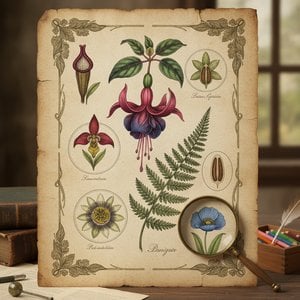
A Life Blossoming in Watercolor: The World of Mary Vaux Walcott
Mary Vaux Walcott, a name synonymous with the delicate beauty and scientific rigor of botanical illustration, emerged from Philadelphia’s Quaker society in 1860 as an unexpected force within the art world. From her earliest years, a profound connection to the natural world—particularly wildflowers—fueled a creative spirit that defied the conventional expectations placed upon women of her time. Her journey wasn't merely one of artistic talent; it was a testament to resilience, intellectual curiosity, and a pioneering spirit that carved a unique path for herself amidst societal constraints. The untimely death of her mother in 1880 thrust young Mary into the role of caregiver for her father and two younger brothers, demanding unwavering devotion while simultaneously nurturing her burgeoning artistic inclinations. This responsibility didn’t stifle her creative flame; rather, it deepened her appreciation for the landscapes they explored together during their annual summer expeditions to the majestic Canadian Rockies – a region that would become the very heart and soul of her art.
The Allure of the Rockies: Nature as Muse and Subject
These annual journeys to the Canadian Rockies were transformative experiences, fundamentally shaping Mary’s artistic vision and scientific understanding. Far from being passive observers, she and her brothers immersed themselves in the rugged grandeur of these mountains, meticulously documenting their surroundings with a combination of artistry and scientific inquiry. They weren't simply admiring the scenery; they were actively studying mineralogy, charting glacial movements through detailed drawings and photographs, and painstakingly recording the intricate details of alpine flora – from the vibrant hues of wildflowers to the delicate structures of mosses and lichens. This wasn’t mere observation; it was a deeply engaged process of scientific investigation, driven by an insatiable curiosity about the natural world. During these expeditions, Mary honed her skills as a botanical illustrator, initially fulfilling requests from botanists eager for accurate depictions of rare and elusive plant species. Her approach was revolutionary for its time – she rendered plants to scale, capturing not just their outward appearance but also their intricate internal structures with remarkable precision. She sought to convey the essence of each flower, revealing its unique beauty and scientific significance through a combination of meticulous detail and artistic sensitivity. Her work stood in stark contrast to many floral paintings of the era, which often prioritized romanticized or stylized representations over scientific accuracy.
A Pioneer’s Path: Breaking Barriers and Defining Style
Mary Vaux Walcott's journey was marked by several significant achievements that challenged societal norms and established her as a pioneering figure in both art and science. Notably, she became the first woman recorded to successfully summit Mount Stephen in 1900 – an extraordinary feat of physical endurance and determination that defied expectations for women at the time. This accomplishment underscored her adventurous spirit and unwavering commitment to exploring the boundaries of human potential. Furthermore, her meticulous documentation of glacial recession alongside her brothers provided invaluable data for understanding climate change decades before it became a widely recognized concern. Her artistic style evolved over time, reflecting her growing scientific knowledge and deepening appreciation for the natural world. Early works often featured looser brushstrokes and a more impressionistic approach, while later paintings demonstrated an increasingly refined technique characterized by precise detail, subtle color gradations, and a remarkable ability to capture the delicate textures of plant surfaces.
A Legacy in Bloom: Collaboration and Recognition
Mary’s life took another pivotal turn in 1914 when she married Charles Doolittle Walcott, then Secretary of the Smithsonian Institution – a union that combined her artistic passion with his scientific expertise. This partnership fostered a unique synergy where art and science intertwined seamlessly. Together, they continued their annual expeditions to the Canadian Rockies, with Charles pursuing his geological research while Mary dedicated herself to her botanical paintings. The Smithsonian Institution became a crucial platform for showcasing her work, culminating in the publication of *North American Wild Flowers* in 1925 – a monumental five-volume collection featuring over 400 of her meticulously crafted illustrations accompanied by detailed descriptions and scientific observations. This publication cemented her reputation as a leading botanical artist and earned her the enduring moniker “The Audubon of Botany,” acknowledging the parallel between her detailed floral studies and John James Audubon’s iconic depictions of birds. Beyond her artistic achievements, Mary Vaux Walcott demonstrated a commitment to public service, serving on the federal Board of Indian Commissioners from 1927 to 1932 and actively advocating for improved conditions on Native American reservations. Her legacy extends far beyond the beauty of her paintings; it represents a testament to the power of curiosity, perseverance, and a deep connection with the natural world.
Key Achievements & Recognition
- Pioneering Botanical Illustration: Renowned for her scientifically accurate and artistically exquisite watercolor paintings of wildflowers.
- “The Audubon of Botany”: Affectionately known by this title, recognizing the significance of her work in botanical art.
- *North American Wild Flowers* (1925): Publication of a five-volume collection showcasing over 400 of her illustrations, solidifying her reputation.
- First Woman to Summit Mount Stephen: A testament to her adventurous spirit and physical endurance.
- Contributions to Glacial Geology: Documented glacial recession in the Canadian Rockies alongside her brothers, providing valuable data for climate change studies.
- Philanthropic Legacy: Bequeathed a significant sum to the Smithsonian Institution to support scientific research.



 Visualizar em escala
 Encomendar reprodução pintada à mão
 Enviar
 Compartilhar
 Ver detalhes
 Guia
Guia

 Baixar imagem
 Semelhantes
 Raio X
 Apresentação de slides
 Estatísticas


 Ver mais






































 A opção de vidro está disponível apenas para tamanhos inferiores a 110 cm