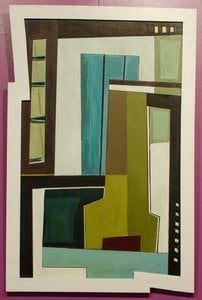
A obra de arte exibida nesta página é protegida por leis de direitos autorais, o que significa que não podemos criar ou vender legalmente uma reprodução idêntica. Esta proteção é aplicada por meio de acordos internacionais, tais como a Convenção de Berna e pelas leis nacionais, incluindo as estabelecidas por Lei de Direitos Autorais dos EUA - Título 17.
Como uma alternativa respeitosa e legal, oferecemos obras de arte personalizadas e pintadas à mão, inspiradas na obra original. Nossos artistas profissionais e experientes estudam cuidadosamente o estilo, a atmosfera e a essência artística da obra original para criar uma peça nova e única que evoque a mesma sensação — permanecendo como uma criação original por direito próprio.
Este método cumpre plenamente as regulamentações de direitos autorais, pois não envolve a cópia ou duplicação da obra protegida. Em vez disso, trata-se de uma reinterpretação criativa — uma nova pintura que é influenciada pela original, mas não idêntica a ela.

Óleo sobre tela pintado à mão no tamanho e moldura de sua escolha, feito sob encomenda pelos nossos artistas. ( Alternar para Impressão
Alternar para Imagem Digital)
Escolha entre os nossos tamanhos pré-definidos que respeitam as proporções originais da obra de arte.
Insira a largura e a altura desejadas para se ajustarem à sua moldura ou parede. Como esta obra é pintada à mão, para um tamanho com proporções diferentes, o artista poderá pintar um pouco mais ao redor da imagem ou reduzir ligeiramente a composição — você escolhe. Enviamos uma maquete digital para sua aprovação antes de iniciar a pintura. A imagem exibida nesta página não representa o resultado real — apenas a maquete mostra o resultado final.

Entrega mundial () em 3 a 4 semanas, em vez das 5 semanas padrão. (27 Outubro). Sem comprometer a qualidade.
El Gran Ritmo
Tamanho da Reprodução
The life of Martin Blaszko was a profound odyssey of displacement, cultural immersion, and artistic evolution. Born in Berlin in 1920, his early years were marked by the shifting borders of a turbulent Europe. As his family moved from Germany to Poland in 1933, and subsequently to France in 19SB8, Blaszko was exposed to a tapestry of diverse environments that would later inform the rhythmic complexity of his work. This nomadic childhood instilled in him a unique perspective, one where identity was not tied to a single landscape but rather to the universal language of form and movement. The eventual migration to Argentina in 1939 provided a new horizon for his creative spirit, allowing him to settle into a period of intense artistic development that would eventually define his place in the annals of modern abstraction.
Blaszko’s artistic language is characterized by a masterful command of geometric abstraction and a deep preoccupation with the concept of order. His work often exists in a delicate balance between the monumental and the intimate. While his sculptures may possess a grandeur that commands the space around them, they are frequently built upon a foundation of precise, calculated movements that suggest a hidden, internal harmony. This duality is perhaps his greatest achievement; he managed to capture the kinetic energy of the modern world within the stillness of static objects. His paintings and sculptures serve as monuments to structural integrity, where every line and plane is a deliberate contribution to a larger, cohesive whole.
Throughout his prolific career, Blaszko remained deeply influenced by the prevailing abstract movements of the 20th century, yet he maintained a signature voice that was entirely his own. His ability to translate complex emotional states into structured, abstract compositions allowed him to transcend mere decoration, reaching instead for a deeper, more primal resonance. The significance of his work lies in this ability to find harmony within complexity—to take the fragmented experiences of a life lived across continents and synthesize them into works that feel both timeless and structurally rigorous.
The legacy of Martin Blaszko continues to resonate through the art world, serving as an inspiration for those who seek to explore the boundaries of shape and space. His contributions can be summarized through several key pillars of his artistic identity:
Though he passed away in Buenos Aires in 2011, Blaszko’s vision remains vibrant. His works stand as a testament to the power of perseverance and the capacity of the human spirit to find beauty and structure amidst the chaos of history.
1920 - 2011 , Germany