x
Visualizar na paredeVisualizar na parede Ver em RAVer em RA Comprar pintura feita à mão Comprar pintura feita à mãoComprar imagem Comprar imagem CompartilharCompartilhar
DetalhesDetalhes Adicionar aos favoritos Adicionar aos favoritos Baixar imagemBaixar imagem SemelhantesSemelhantes Raio XRaio X SlideshowSlideshow

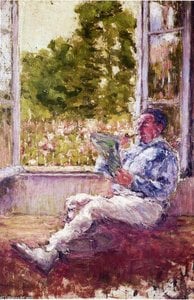
Man sitting beside a window

Marcel Duchamp’s ‘Man seated by a window,’ painted in 1907, exemplifies Post-Impressionism and explores themes of leisure and contemplation. Acquired from Duchamp's widow, Madame Roché, through Cordier & Ekstrom, it now resides at MoMA, where provenance research continues to illuminate its history.

Marcel Duchamp: artista francês que revolucionou a arte ao desafiar conceitos tradicionais e usar objetos cotidianos como obras de arte, marcando o início da arte conceitual.

Giclée / Impressão de Arte

Impressão giclée ou em tela de qualidade de museu, com produção rápida e opções flexíveis de acabamento. (Comprar pintura feita à mão Comprar pintura feita à mãoComprar imagem Comprar imagem)

P118B $10
P118H $10
P118W $10
P438Z $10
P508JH $12
P508YH $12
P805H $10
P805Z $10
P919BZ $10
P919G $10
P919XJ $10
P959ZH $10
P968JZ $12
W106C $8
W218G $10
W218JH $8
W218Y $10
W307PJ $10
W316G $10
W316PJ $8
W316Y $10
W398PJ $8
W4111J $10
W500HY $15
W500JH $15
W692G $12
W849H $8
W940BG $15
W953PJ $8

Tamanho padrão
personalizado
CM
INCH

Escolha entre os nossos tamanhos pré-definidos que respeitam as proporções originais da obra de arte.

largura
altura

Você pode inserir suas próprias dimensões para se ajustar a uma moldura ou espaço específico. Se o tamanho selecionado não corresponder às proporções da imagem original, iremos recortar a obra de arte ou estender a imagem com uma borda espelhada ou preenchimento sólido. Um mockup digital será enviado para sua aprovação antes do início da produção.
Por favor, observe que a visualização na tela não reflete o recorte ou a extensão real. Apenas o mockup mostrará com precisão a composição final.
Embora tamanhos personalizados estejam disponíveis, recomendamos selecionar uma dimensão da lista predefinida para preservar as proporções originais.

Entrega mundial () em 2 semanas, em vez das 4/5 semanas padrão. (3 Setembro)

why_choose_icon
Envio expresso gratuito para todo o mundo
why_choose_icon
Tela de Linho de Alta Qualidade
why_choose_icon
Seguro de transporte completo
why_choose_icon
Garantia de Reembolso de Impostos Alfandegários
why_choose_icon
Garantia de Fidelidade Cromática
why_choose_icon
Política de Devolução em 60 Dias (Apenas para Defeitos)
why_choose_icon
Garantia de reembolso de 100%
why_choose_icon
Oferta de desconto por quantidade

Preço Total

$ 68

reproduction

Man sitting beside a window

Giclée / Impressão de Arte

Tamanho da Reprodução

-

Preço Total

$ 68

Informações Rápidas

  • Notable elements or techniques: Floral arrangement; Window view
  • Artistic style: Symbolic
  • Influences: Paul Cézanne
  • Artist: Marcel Duchamp
  • Dimensions: 55.6 x 38.7 cm
  • Location: Museum of Modern Art (MoMA)
  • Year: 1907

Quiz de Arte

Cada pergunta possui apenas uma resposta correta.

Pergunta 1:
What artistic movement is Marcel Duchamp's “Man seated by a window” considered to be?
Pergunta 2:
The painting depicts a man engaged in what activity?
Pergunta 3:
What is the predominant color palette used in “Man seated by a window”?
Pergunta 4:
Where was Marcel Duchamp born?
Pergunta 5:
What is a notable characteristic of Duchamp's approach to art that distinguishes him from traditional painters?

A Moment of Quietude: The Soul of Duchamp’s Early Mastery

In the vast, often turbulent history of modern art, there exists a rare, fleeting moment where the revolutionary spirit of Marcel Duchamp was still anchored in the serene beauty of the visible world. Man Seated by a Window, painted in 1907, captures this exquisite tension. Before he became the iconoclast who would dismantle the very definition of art through Dada and Readymades, Duchamp was a painter deeply engaged with the sensory delights of his surroundings. This piece invites the viewer into a private sanctuary, presenting a solitary figure lost in thought, framed by the soft light of a window and the vibrant life of blossoming flora. It is not merely a depiction of a man at rest; it is an invitation to pause, to breathe, and to find resonance in the quiet intervals of existence.

The composition functions as a delicate dialogue between the interior and the exterior worlds. As the eye wanders across the canvas, one encounters a masterful use of Post-Impressionist techniques that prioritize emotional atmosphere over rigid anatomical precision. The artist employs loose, gestural brushstrokes that imbue the scene with a sense of living movement—the gentle sway of leaves, the dappled light filtering through the glass, and the soft texture of the man's clothing. This stylistic choice creates a luminous quality, where the muted blues and greens of the background harmonize with warmer, sun-drenched hues from the garden outside, establishing a visual equilibrium that is both soothing and intellectually stimulating.

Technique and the Art of Atmosphere

Executed in oil on canvas, the painting showcases Duchamp’s formidable command over medium and light. The texture of the oil paint allows for a rich layering of color, which lends depth to the shadows within the room and brilliance to the petals of the flowers. For the discerning collector or interior designer, this work offers a sophisticated interplay of tones that can anchor a room with its tranquil energy. Unlike the starker, more clinical works of later modernism, this painting possesses a tactile warmth; it feels inhabited, as if the scent of the garden could drift through the frame. The way the light interacts with the subject suggests a daytime setting filled with the gentle vitality of spring or summer, making it an ideal centerpiece for spaces designed for contemplation and repose.

Beyond its aesthetic charm, the painting serves as a profound historical document. It captures a period of transition in art history, where the boundaries between Impressionism and the burgeoning movements of Cubism were still being negotiated. In this work, we see the seeds of Duchamp’s later philosophical inquiries—the way he uses the window not just as a physical object, but as a metaphorical lens through which we perceive reality. To possess a reproduction of this masterpiece is to hold a piece of the very foundation of modern thought, wrapped in the beautiful, accessible language of classical beauty.

An Inspiration for the Modern Interior

For those looking to curate an environment of elegance and intellectual depth, Man Seated by a Window offers unparalleled versatility. Its palette—a sophisticated blend of organic greens, deep blues, and soft floral accents—complements a wide array of interior styles, from contemporary minimalism to classic European aesthetics. The painting’s ability to evoke a sense of peace makes it a transformative element in a study, a library, or a quiet corner of a living space. It does not demand attention through noise, but rather commands respect through its profound stillness, acting as a window into a more thoughtful and reflective way of being.


Biografia do Artista

Marcel Duchamp, A Revolutionary Spirit: The Life and Art of Marcel Duchamp

Marcel Duchamp, born Henri-Robert-Marcel Duchamp in 1887 in Blainville-Crevon, Normandy, was more than an artist; he was a philosophical provocateur who fundamentally altered the course of modern art. His early life, though seemingly conventional – nurtured within a family that appreciated artistic expression with both brothers pursuing successful careers as artists – hinted at the iconoclasm to come. Duchamp initially pursued formal training, mastering traditional techniques and experimenting with post-impressionist styles. However, this academic foundation served not as an end in itself, but as a springboard for questioning the very nature of art, its purpose, and its definition. He wasn’t content merely to depict the world; he sought to challenge how we perceive it, and what constitutes artistic value. This restless intellectual curiosity would become the defining characteristic of his prolific career.

Early Artistic Explorations: Cubism and Impressionism

Duchamp's initial foray into art began with a grounding in traditional techniques—primarily painting—influenced by Impressionism and Post-Impressionism. He honed his skills studying under Gustave Moreau at École Supérieure des Beaux-Arts in Paris, absorbing the stylistic innovations of artists like Cézanne and Picasso. His early canvases demonstrate an aptitude for capturing light and color, reflecting a sensitivity to visual aesthetics. However, Duchamp quickly recognized that mere imitation wasn’t sufficient to express his profound ideas about art and its role in society. The devastating impact of World War I profoundly affected him, fueling disillusionment with the prevailing artistic conventions of the time. This experience spurred him toward a radical rethinking of artistic practice—a rejection of established norms and a determination to disrupt accepted notions of beauty.

The Dadaist Rebellion: Challenging Artistic Conventions

Duchamp’s engagement with Dadaism marked a decisive turning point in his artistic trajectory. Emerging from the disillusionment following World War I, Dada rejected logic, reason, and traditional artistic values—a defiant stance against the perceived hypocrisy of bourgeois society. Artists like Tristan Tzara, Hugo Ball, and Hans Arp embraced absurdity and chance as creative tools, producing performances and collages that deliberately undermined conventional aesthetic standards. Duchamp’s contribution to Dada was particularly significant: he championed the concept of “readymade”—ordinary manufactured objects presented as art—a provocative gesture designed to dismantle hierarchies within the art world. His most famous readymade, *Fountain* (1917), consisted of a porcelain urinal signed "R. Mutt," submitted anonymously to Marcel Duchamp’s own exhibition in New York City. This audacious act challenged the very definition of artistic skill and authorship—was it the artist's hand that created the work, or was it merely the artist’s conceptual intervention?

The Readymades: Conceptual Art Takes Root

Duchamp’s exploration of readymades solidified his position as a pioneer of Conceptual Art. He argued that the essence of art resided not in its visual appearance but in its underlying idea—a notion that fundamentally shifted the focus from craftsmanship to intellectual inquiry. Other notable readymades included *L.H.O.O.Q.* (1919), a reproduction of Leonardo da Vinci’s Mona Lisa overlaid with a mustache and goatee, and *The Large Glass* (1915–1923), an ambitious multi-faceted artwork incorporating glass panels, mirrors, and intricate engravings—a testament to Duchamp's meticulous attention to detail and his unwavering commitment to challenging artistic conventions. These works weren’t intended to elicit admiration for their aesthetic qualities; they were designed to provoke contemplation and confront viewers with uncomfortable questions about art history and cultural values.

Legacy and Enduring Influence

Marcel Duchamp’s influence on subsequent generations of artists is undeniable. He irrevocably transformed our understanding of art, establishing Conceptual Art as a dominant force in the latter half of the 20th century. His insistence that the artist's concept superseded visual form continues to inspire creativity today—artists grapple with questions of authorship, originality, and the role of intention in artistic creation. Duchamp’s unwavering belief in intellectual rigor and his willingness to disrupt established norms cemented his place as one of the most important figures in modern art history. His legacy persists, urging artists to question assumptions and embrace radical experimentation—a challenge that resonates powerfully within contemporary artistic discourse. He remains a symbol of artistic freedom and intellectual provocation, demonstrating that true innovation lies not merely in mastering technique but in confronting fundamental questions about what constitutes art itself.
Marcel Duchamp

Marcel Duchamp

1887 - 1968 , França

Dados Rápidos

  • Artistic Movement Or Style:
    • Cubismo
    • Dadaísmo
  • Artists Or Movements Influenced By This Artist: ['Minimalismo']
  • Date Of Birth: 28 Jul 1887 Blainville
  • Date Of Death: 2 Oct 1968
  • Full Name: Marcel Duchamp Henri-Robert-Marcel
  • Nationality: Francês-Americano
  • Notable Artworks:
    • Fonte
    • L.H.O.O.Q.
    • Grande Cristal
  • Place Of Birth: Normandia França
Explore obras de arte organizadas por temas, estilos e características.