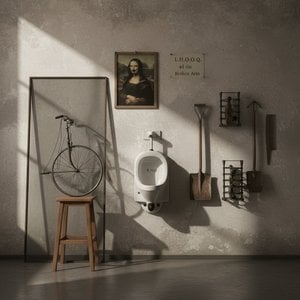
A Life Illuminated by Shadows
Emmanuel Radnitzky, a name that would eventually transform into Man Ray, was born in Philadelphia in 1890 to Russian Jewish immigrant parents, Melach “Max” Radnitzky and Manya “Minnie” Radnitsky (née Lourie or Luria). His early life, steeped in the vibrant energy of New York City, proved formative, exposing him to a burgeoning artistic landscape and instilling within him a lifelong fascination with experimentation. He wasn’t destined for a conventional path; his family's background, marked by both financial struggles and a strong sense of social justice – evident through their involvement with anarchist ideals – fostered an environment where questioning established norms was not just tolerated but actively encouraged. His father, a tailor, and his mother, a seamstress, instilled in him a deep appreciation for craftsmanship and the transformative power of creative labor. He completed his high school education, initially intending to pursue architecture, yet ultimately choosing the path of an artist, a decision fueled by a desire to break free from the constraints of societal expectations and explore the boundless possibilities of self-expression.
Early Influences and the Rise of “Man Ray”
Ray’s artistic journey began with a deep immersion in European modernism, largely through the lens of Alfred Stieglitz's 291 gallery in New York City. This exposure to Cubism, Futurism, and other avant-garde movements ignited within him a burning desire to challenge traditional modes of representation. Simultaneously, he found himself drawn to the gritty realism of the Ashcan School, a movement that documented the lives of ordinary people in urban America with unflinching honesty. This confluence of influences—the intellectual stimulation of European modernism and the social commentary of American realism—shaped his early artistic vision, creating a unique synthesis that would inform his subsequent work. The shift from “Manny” Radnitzky to the enigmatic “Man Ray” itself was a deliberate act of self-invention, a symbolic rejection of familial constraints and an assertion of individual identity. It represented a conscious decision to forge a new persona—a creative force unbound by convention.
Dadaism and the Birth of a New Aesthetic
The arrival of Marcel Duchamp in New York around 1915 proved to be a pivotal moment in Man Ray’s artistic trajectory. Their shared fascination with challenging established notions of art led them to become central figures in the burgeoning Dada movement, an anti-art protest born from the disillusionment following World War I. Dada artists sought to dismantle traditional values and embrace absurdity, chance, and spontaneity as a means of critiquing societal norms. Man Ray’s involvement with Dada extended beyond mere participation; he actively contributed to its development in New York, co-founding the Society of Independent Artists alongside Duchamp and Katherine Dreier. The group's publication of *New York Dada* in 1921, though short-lived, marked a significant attempt to establish Dada as a viable artistic force within American culture. This period was characterized by experimentation with “ready-mades”—ordinary manufactured objects elevated to the status of art—a radical concept that challenged the very definition of what constituted art.
Rayographs and the Alchemy of Light
It was during this time, in 1922, that Man Ray stumbled upon a revolutionary technique: the rayograph. While experimenting with photography, he discovered that by placing objects directly onto light-sensitive paper and exposing them to light, he could create ethereal, ghostly images—a process he termed “rayographs.” This wasn’t simply an alternative method of image-making; it was a profound philosophical statement about the nature of photography itself. By eliminating the camera lens, Ray stripped away the illusion of objectivity, revealing the inherent subjectivity of the medium. These weren't representations *of* things, but rather direct imprints *from* them, imbued with a sense of mystery and otherworldliness. He continued to refine his technique throughout the 1920s and 30s, experimenting with solarization—a process that created dramatic reversals of tone—and multiple exposures, pushing the boundaries of photographic expression. His rayographs became increasingly abstract, exploring the interplay of light, shadow, and form in a way that defied conventional representation.
Surrealism, Film, and a Lasting Legacy
Man Ray’s artistic explorations extended beyond still photography into the realm of filmmaking. His experimental films, such as *Le Retour à la Raison* (1923) and *L'Étoile de Mer* (1928), were characterized by their surreal imagery, unconventional editing techniques, and rejection of narrative conventions. These weren’t stories told in a traditional sense; they were visual poems, explorations of form, rhythm, and the subconscious. He employed innovative techniques like stop-motion animation and superimposition to create disorienting and dreamlike effects. He became a key figure within the Surrealist movement, collaborating with artists like Salvador Dalí and contributing significantly to the journal *Surréalisme*. His work during this period is marked by a fascination with dreams, the irrational, and the hidden depths of the human psyche. Man Ray died in Paris in 1976, leaving behind a remarkable body of work that continues to inspire artists and audiences worldwide. His legacy lies not only in his technical innovations but also in his unwavering commitment to artistic freedom and his relentless pursuit of the impossible—a true pioneer who forever altered our perception of art and reality.
- Photography: Man Ray’s techniques, particularly rayography and solarization, continue to be explored by contemporary photographers.
- Surrealism: His contributions solidified the movement's visual language and inspired countless artists across disciplines.
- Experimental Film: His pioneering work in film laid the groundwork for future generations of avant-garde filmmakers.
- Fashion Photography: Ray’s innovative approach to portraiture and composition influenced the development of modern fashion photography.



 Visualizar em escala
 Encomendar reprodução pintada à mão
 Enviar
 Compartilhar
 Ver detalhes
 Guia de Obras do Aluno

 Baixar imagem
 Semelhantes
 Raio X
 Apresentação de slides
 Estatísticas

 Ver mais






































 A opção de vidro está disponível apenas para tamanhos inferiores a 110 cm